VOO and Chill: The Surprisingly Powerful Investment Strategy That Almost Anyone Can Follow
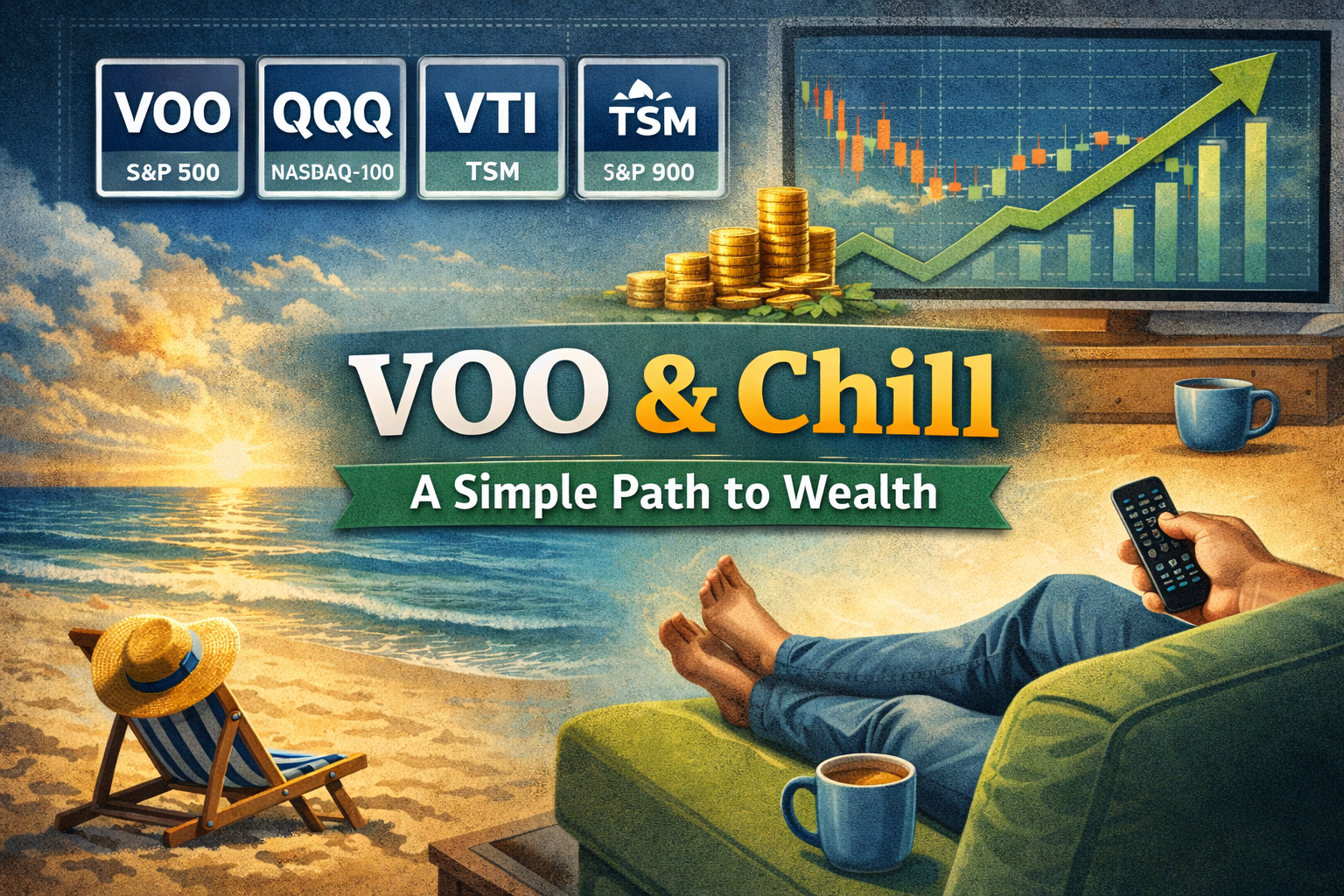 In the age of trading apps, real-time charts, and endless financial news, investing can look incredibly complicated. Scroll through social media and you’ll see people debating technical indicators, short-term options trades, and intricate strategies that sound more like engineering projects than personal finance.
Yet despite all that complexity, one of the most effective investing strategies to emerge in recent years has a name that sounds almost like a joke:
“VOO and chill.”
The phrase is a play on the popular internet meme “Netflix and chill,” but the concept behind it is serious. The idea is simple: instead of constantly trading stocks or trying to predict the market, you just invest consistently in a broad market ETF like VOO, VTI, or sometimes QQQ, and then… you relax.
No day trading.
No complicated spreadsheets.
No obsessing over charts every night.
Just long-term investing and patience.
While it might sound overly simplistic, this strategy has gained popularity among investors for one important reason: historically, it works remarkably well.
What “VOO and Chill” Actually Means
At its core, the strategy revolves around buying a low-cost index fund and holding it for a long time.
Most commonly, investors refer to VOO, which is the Vanguard S&P 500 ETF. But similar strategies involve other funds like VTI (Vanguard Total Stock Market ETF) or QQQ (the ETF that tracks the Nasdaq-100).
The idea is straightforward:
-
Regularly invest money into one of these ETFs.
-
Reinvest dividends.
-
Ignore short-term market swings.
-
Hold the investment for years or decades.
Instead of trying to pick individual winners, you simply buy a fund that represents a large portion of the stock market itself.
And because the overall market tends to grow over time, investors who follow this strategy benefit from that long-term growth.
Why ETFs Like VOO, VTI, and QQQ Are So Popular
The reason these ETFs work well for long-term investors comes down to diversification and simplicity.
When you buy one share of VOO, you’re not buying just one company. You’re buying a tiny piece of 500 of the largest companies in the United States.
These include companies like:
-
Apple
-
Microsoft
-
Amazon
-
Google
-
Johnson & Johnson
-
Coca-Cola
-
Visa
-
Nvidia
Instead of betting your financial future on one company succeeding, you’re investing in the entire system of large American businesses.
VTI takes diversification even further by representing almost the entire U.S. stock market, including thousands of companies of all sizes.
QQQ is a little different because it focuses heavily on technology and growth companies in the Nasdaq-100. It’s more concentrated, but it has historically produced strong returns thanks to the dominance of tech giants.
In every case, however, the principle is the same: broad exposure to successful companies.
The Historical Power of the Market
One of the reasons “VOO and chill” has become so popular is the long-term track record of the stock market.
Over long periods of time, the U.S. stock market has historically returned around 8–10% per year on average.
Of course, those returns don’t happen in a straight line. Some years are spectacular. Others are painful.
Markets crash. Recessions happen. Bubbles form and burst.
But zoom out over decades and the overall trend has historically been upward.
That’s because the stock market ultimately reflects the growth of businesses and the economy itself. Companies innovate, expand into new markets, develop new technologies, and generate profits.
When businesses grow, stock prices tend to follow.
Investing in broad market ETFs allows you to capture that growth without needing to identify which specific company will succeed.
Why Most Active Traders Underperform
One of the biggest arguments in favor of the “VOO and chill” strategy is the performance gap between passive investing and active trading.
Many investors believe that by studying charts, analyzing financial statements, or timing market movements they can outperform the broader market.
Some traders do succeed.
But many don’t.
Numerous studies have shown that a large percentage of active investors fail to beat the market over long periods of time. Even professional fund managers often struggle to outperform simple index funds after accounting for fees and costs.
There are several reasons for this.
First, markets are incredibly competitive. Millions of investors around the world are constantly analyzing information and making trades. Any obvious opportunity tends to disappear quickly.
Second, active trading introduces more chances to make mistakes. Every trade has the possibility of being wrong.
Third, trading frequently often leads to emotional decisions. Fear and greed can cause investors to buy high during excitement and sell low during panic.
By contrast, passive investing reduces these problems. When you simply invest in an index fund and hold it long-term, you avoid many of the traps that hurt active traders.
The Psychological Advantage
One of the underrated benefits of the “VOO and chill” strategy is its psychological simplicity.
Constantly trading the market can be mentally exhausting. Watching every price movement, worrying about news events, and trying to time entries and exits can create a lot of stress.
Long-term index investors approach the market very differently.
They accept that volatility is normal. Instead of reacting to every market swing, they focus on the bigger picture.
If the market drops, they continue investing.
If the market rises, they continue investing.
The strategy removes much of the emotional pressure associated with investing.
You’re not trying to win every trade. You’re simply participating in the long-term growth of the market.
The Role of Dollar-Cost Averaging
Many investors who follow this strategy use a method called dollar-cost averaging.
This simply means investing a fixed amount of money at regular intervals — for example, every paycheck or every month.
Sometimes the market will be high when you invest. Sometimes it will be low.
Over time, this approach spreads your purchases across different price levels, which reduces the risk of investing a large amount of money at the wrong time.
Dollar-cost averaging also reinforces discipline. Instead of waiting for the “perfect” moment to invest, you just follow a consistent schedule.
Consistency often beats timing.
The Importance of Low Fees
Another reason ETFs like VOO and VTI are so attractive is their extremely low fees.
Many actively managed mutual funds charge management fees that can exceed 1% per year. That might not sound like much, but over decades those fees can significantly reduce your returns.
Index ETFs, on the other hand, are very inexpensive.
VOO, for example, has an expense ratio of only a few hundredths of a percent.
That means more of your investment returns stay in your account rather than going to fund managers.
Over long time horizons, lower fees can make a surprisingly large difference.
Why Time Is the Most Powerful Factor
One of the most important elements of the “VOO and chill” strategy isn’t the ETF itself.
It’s time.
The longer money stays invested in the market, the more powerful compounding becomes.
Compounding occurs when investment gains generate additional gains. Over many years, this effect can accelerate dramatically.
For example, an investment that grows at around 8–10% annually can double roughly every 7–9 years.
That means money invested today could potentially grow many times over if left untouched for decades.
This is why long-term investors often emphasize starting early. The earlier you begin investing, the more time compounding has to work.
What About Market Crashes?
One of the biggest fears new investors have is the possibility of a market crash.
History shows that crashes do happen.
The stock market has experienced major downturns during events like:
-
The Great Depression
-
The 2000 dot-com crash
-
The 2008 financial crisis
-
The 2020 pandemic crash
During these periods, markets can fall dramatically in a short time.
But history also shows that markets have eventually recovered and continued growing over the long term.
Investors who panic and sell during crashes often lock in losses.
Those who remain invested — or continue investing during downturns — often benefit from the eventual recovery.
The “VOO and chill” strategy relies on accepting that downturns are part of the journey.
When This Strategy Might Not Be Ideal
While “VOO and chill” is effective for many investors, it isn’t perfect for everyone.
Some people genuinely enjoy analyzing companies, researching investments, and actively managing portfolios. For them, investing is both a financial activity and an intellectual hobby.
Others may prefer more diversified strategies that include international stocks, bonds, or real estate.
And some investors have shorter time horizons where market volatility becomes a bigger concern.
But for many individuals — especially those focused on long-term wealth building — simple index investing remains a strong option.
Why Simplicity Often Wins
In many areas of life, people assume that complicated strategies produce better results.
But investing often works the opposite way.
Complex strategies introduce more variables, more opportunities for mistakes, and more emotional stress.
Simple strategies are easier to follow consistently.
And consistency is one of the most important ingredients of long-term investing success.
By investing regularly, keeping costs low, staying diversified, and holding investments for long periods, investors give themselves a strong foundation for growth.
That’s exactly what the “VOO and chill” philosophy encourages.
The Bottom Line
Despite the endless financial analysis available online, successful investing doesn’t always require complex strategies.
Sometimes the most effective approach is also the simplest.
The “VOO and chill” philosophy captures this idea perfectly. Instead of trying to outsmart the market every day, investors focus on long-term participation in the growth of the economy.
They buy broad market ETFs like VOO, VTI, or QQQ.
They invest consistently.
They ignore short-term noise.
And they let time and compounding do the heavy lifting.
It may not sound exciting compared to day trading or chasing the latest hot stock.
But over the long run, simplicity has proven to be surprisingly powerful.
Sometimes the smartest investing strategy is the one that lets you stop worrying about the market — and just let it work for you.

Investing Isn’t Rocket Science: Why the Stock Market Is Simpler Than People Think

Understanding the Greeks in Stock Options: The Hidden Forces That Control Option Prices
About The Author
