The 5-Minute Opening Candle Strategy Is a Joke: Why This Popular Day Trading Method Falls Apart Under Real Testing
 Every few years a trading strategy sweeps through the internet like wildfire. It shows up in YouTube videos, Discord groups, paid trading courses, and endless social media posts promising a “simple edge” in the market.
One of the most popular examples is the 5-minute opening candle strategy.
If you spend any time watching day trading content online, you’ve probably heard it promoted. The pitch always sounds appealing because it promises something every trader wants: a clear, repeatable system that supposedly reveals the direction of the market early in the trading day.
The rule is simple.
Wait for the first five-minute candle after the market opens. Then trade based on whether the stock breaks above or below that candle’s range.
It sounds clean. It sounds logical. It sounds like the kind of mechanical system that should produce consistent results.
But when you actually test it seriously, the reality becomes painfully clear:
The strategy is garbage.
Not “slightly flawed.”
Not “needs tweaking.”
Not “works only in certain market conditions.”
It’s simply a coin flip disguised as a trading system.
What the 5-Minute Opening Candle Strategy Claims
Before explaining why the strategy fails, it’s important to understand what its supporters claim it does.
The basic idea revolves around the belief that the first few minutes of the trading day reveal the market’s true direction.
Proponents argue that during the opening minutes, institutions and large traders place their orders. By watching the range of the first five-minute candle, traders supposedly gain insight into whether buyers or sellers are in control.
The typical rules look something like this:
-
Wait for the first five-minute candle after the market opens.
-
Mark the high and low of that candle.
-
If price breaks above the high, go long.
-
If price breaks below the low, go short.
-
Use the opposite side of the candle as a stop loss.
Variations exist, but this is the core idea.
It sounds elegant because it gives traders a structured plan: wait for the first candle, then trade the breakout.
Unfortunately, elegance doesn’t equal effectiveness.
Why the Strategy Sounds Convincing
The reason the 5-minute opening candle strategy spreads so easily online is because it feels intuitive.
There’s a psychological appeal to the idea that the opening minutes of the market reveal important information.
After all, the market just spent the entire night closed. Overnight news, earnings reports, and global events have accumulated. When the market opens, all of that information gets priced in quickly.
So it’s tempting to believe that the first candle reflects the market’s true direction.
But markets don’t work that neatly.
The opening minutes are often chaotic.
Orders from overnight trading, institutional adjustments, algorithmic trading, and retail speculation all collide at once. Prices can whip back and forth rapidly before settling into a more stable trend.
In other words, the opening candle is often noise, not a reliable signal.
What Happens When You Actually Test It
The real problem with the strategy becomes obvious when you remove emotion and simply run the numbers.
Instead of relying on cherry-picked charts or selective examples, imagine testing the strategy across thousands of trading days and multiple major stocks.
A serious test was conducted using 5,000 trading days of historical data across some of the most heavily traded companies in the market:
-
Apple
-
Nvidia
-
Microsoft
-
Intel
-
Meta
-
Tesla
-
Amgen
-
Johnson & Johnson
Along with major market ETFs:
-
SPY
-
QQQ
These are some of the most liquid and widely traded securities in existence. If the strategy had any real edge, it should show up here.
But the results were ugly.
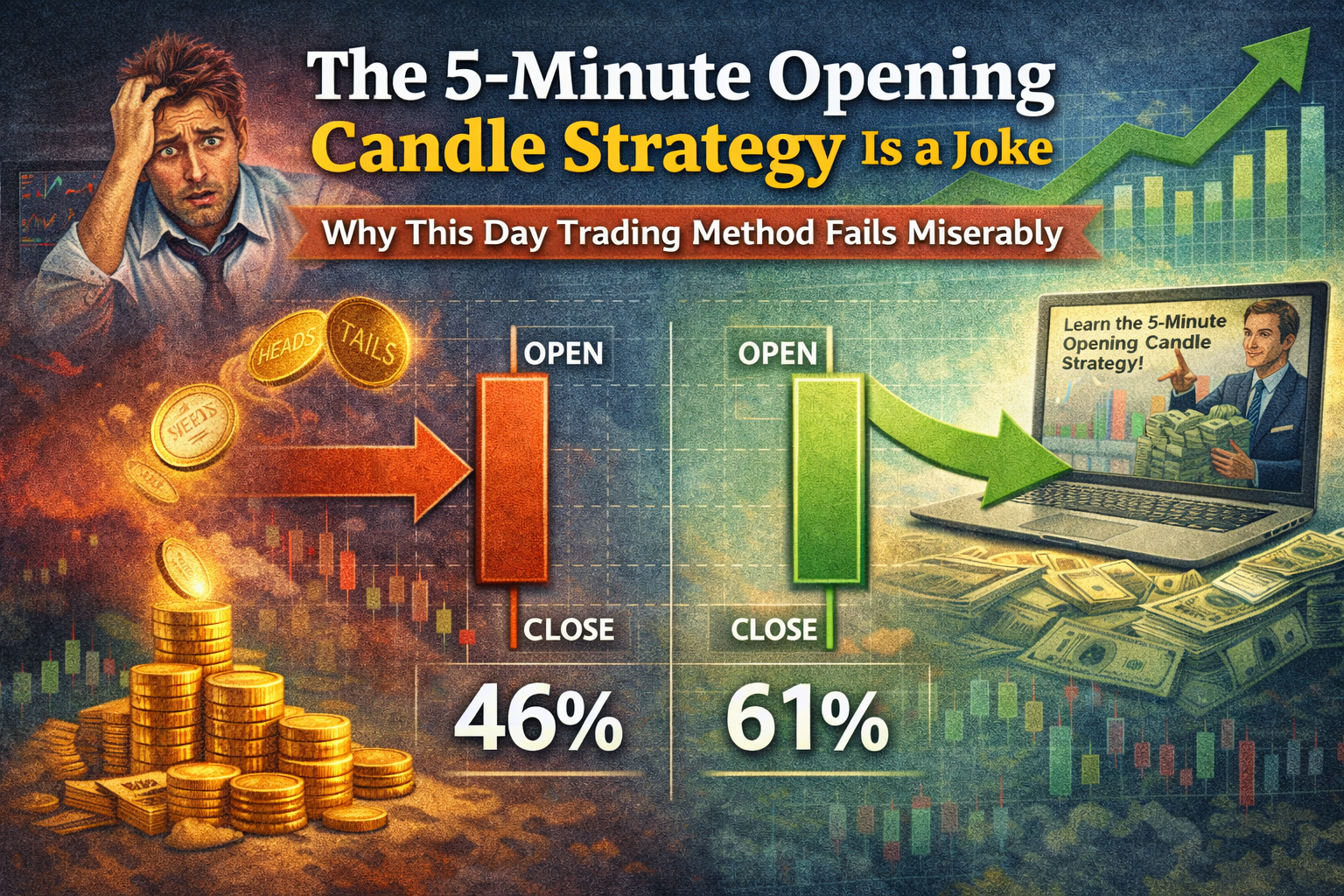
Across the entire dataset, the 5-minute opening candle breakout strategy produced only a 46% success rate.
That means the trade direction was wrong more often than it was right.
Not slightly wrong.
Consistently wrong.
The Coin Flip Problem
A 46% win rate should immediately raise alarm bells.
In trading, a system that performs worse than random chance isn’t an edge — it’s a liability.
If a strategy were truly predictive, you would expect the success rate to be meaningfully above 50%.
Instead, the results suggest the strategy is essentially random.
Or worse than random.
Which raises an uncomfortable question: if the system is barely better than guessing, why do so many people promote it?
The Only Reason It Sometimes Shows Profit
Supporters of the strategy often respond with a common defense.
They argue that the system still works because it uses a 2:1 reward-to-risk ratio.
In other words, traders risk one unit of loss for every two units of potential profit.
This means that even with a lower win rate, the strategy can theoretically remain profitable.
And technically, that’s true.
But this isn’t proof of an edge in the strategy itself.
It simply means that any coin-flip system can appear profitable if the reward-to-risk ratio is large enough.
You could design countless random trading strategies that show occasional profit simply by manipulating the risk-reward ratio.
That doesn’t mean the underlying signal has predictive power.
It just means the math of the payout structure is doing the heavy lifting.
The Embarrassing Alternative Test
Here’s where things get even more revealing.
Instead of using the breakout of the opening candle, another test was conducted using a hilariously simple method.
Forget breakouts. Forget ranges.
Just look at the color of the first five-minute candle.
If the candle is green, go long.
If the candle is red, go short.
That’s it.
No complicated rules.
No breakout levels.
No special indicators.
Just trade in the direction of the candle color.
The results?
A 61% success rate.
That’s dramatically better than the official breakout strategy.
Let that sink in.
A strategy based on nothing more than the color of a candle outperformed the supposedly “sophisticated” 5-minute breakout system.
That alone should tell you everything you need to know.
Why Breakouts Fail So Often
One of the main reasons the strategy struggles is because opening breakouts frequently reverse.
During the first few minutes of trading, volatility is extremely high.
Prices can spike quickly in one direction, triggering breakout traders.
But once the initial surge fades, the move often reverses.
This phenomenon is known as a false breakout.
And it happens constantly during the opening minutes of the market.
Professional traders know this.
In fact, many experienced traders actually look for opportunities to trade against opening breakouts once the momentum fades.
The Course Seller Problem
If the strategy performs so poorly, why is it so widely promoted online?
The answer is simple.
Because it’s easy to sell.
The 5-minute opening candle strategy checks all the boxes for marketing.
It’s simple.
It sounds logical.
It provides clear rules.
And it produces occasional winning trades that can be showcased in promotional material.
For someone selling an online trading course, that’s perfect.
They don’t need a strategy that works consistently.
They just need one that looks convincing enough to attract customers.
Cherry-Picked Charts
Another reason the strategy appears effective online is because of cherry-picked examples.
You’ll often see screenshots of perfect breakout trades where the stock explodes upward immediately after breaking the opening range.
These trades absolutely do happen.
But they’re not the typical outcome.
What you don’t see in the promotional material are the countless failed trades where the breakout reverses immediately.
Or the days where price chops sideways and hits both the stop loss and profit target unpredictably.
When only the best examples are shown, any strategy can appear brilliant.
The Psychology of Easy Systems
People are naturally drawn to systems that promise simplicity.
Trading is difficult and uncertain. A strategy that offers clear rules and predictable outcomes is incredibly appealing.
The 5-minute opening candle strategy fits that desire perfectly.
It tells traders exactly what to do.
Wait five minutes.
Mark the range.
Trade the breakout.
The simplicity makes it feel reliable.
But markets don’t reward simplicity unless it’s backed by genuine statistical advantage.
And in this case, the advantage simply isn’t there.
Real Edges Are Rare
Another uncomfortable truth about trading is that real edges are extremely difficult to find.
Professional traders spend years analyzing data, building models, and studying market behavior.
Even then, many strategies stop working once they become widely known.
The idea that a simple breakout rule from a single five-minute candle provides a reliable edge across thousands of stocks and trading days is highly unrealistic.
If such a simple rule truly worked consistently, institutional traders would exploit it instantly.
The edge would disappear almost immediately.
The Data Doesn’t Lie
At the end of the day, trading strategies should be judged by one thing:
Data.
Not anecdotes.
Not YouTube testimonials.
Not cherry-picked examples.
Actual historical performance.
When the 5-minute opening candle strategy is tested across thousands of trading days and multiple major stocks, the results are clear.
A 46% success rate.
That’s worse than flipping a coin.
Meanwhile, the laughably simple candle-color approach produced a 61% success rate.
That alone exposes how weak the breakout strategy really is.
The Bottom Line
The 5-minute opening candle strategy has become one of the most widely promoted day trading systems on the internet.
Unfortunately, its popularity has little to do with its effectiveness.
When tested across 5,000 trading days using major stocks like Apple, Nvidia, Microsoft, Tesla, and others, the strategy barely performs better than random chance.
Its 46% success rate reveals a system with no meaningful predictive power.
The only reason it sometimes appears profitable is because of risk-reward math, not because the signal itself is useful.
Meanwhile, a hilariously simple approach — trading based on the color of the opening candle — produced far better results.
Yet that strategy doesn’t get promoted in expensive online trading courses.
Why?
Because it’s too simple to sell.
The uncomfortable truth is that many of the strategies marketed by online trading “gurus” exist not because they work, but because they sound convincing enough to attract paying customers.
In reality, the 5-minute opening candle strategy isn’t a secret edge.
It’s just another example of how easily traders can be misled by systems that look good on the surface but collapse under real data.
And once you see the numbers, it becomes obvious.
The strategy isn’t clever.
It isn’t powerful.
It isn’t a hidden market secret.
It’s just a coin flip wearing a fancy disguise.

The $1 Million Bitcoin Fantasy: Why the Math Simply Doesn’t Work

Cash Secured Puts: The Strategy That Feels Like an Ultra-High Yield Savings Account

The Wheel Strategy: One of the Most Reliable Income Strategies in Options Trading
About The Author
