Why Most Options Traders Lose Money: The Reality Behind the Statistics
 Options trading has exploded in popularity over the last decade. Commission-free brokerages, easy-to-use trading apps, and endless posts on social media have brought millions of new traders into the options market. It’s now common to see screenshots online showing someone turning a few hundred dollars into thousands with a well-timed call or put.
Those success stories spread fast.
But they also create a distorted view of how options trading actually works.
The truth is that most options traders lose money, especially those who primarily buy calls and puts hoping for quick gains. The statistics behind options markets tell a much less glamorous story than what you usually see on Reddit or YouTube.
Contrary to some exaggerated claims online, it’s not true that 90% of options expire worthless. But even the real numbers still paint a difficult picture for traders hoping to consistently make money buying options.
And when you look closely at those numbers, the odds become clear: losing money on options is more common than making a profit.
What the Real Options Statistics Say
The Chicago Board Options Exchange (CBOE), one of the largest options exchanges in the world, has published statistics showing how options contracts actually end their life cycle.
While the exact percentages vary slightly depending on the time period and the type of option, the broad breakdown looks something like this:
-
30–40% of options expire worthless
-
20–30% are closed early for a loss
-
About 10% are exercised
-
Around 20–30% are closed early for a profit
These numbers are important because they highlight something many new traders don’t realize.
When people say options “expire worthless,” that means the buyer loses 100% of the money they paid for the contract.
If you buy a call or put for $500 and it expires worthless, the entire $500 is gone.
The Myth That 90% Expire Worthless
You’ll often hear the claim that 90% of options expire worthless.
This statistic gets repeated constantly online and is usually used by option sellers to emphasize their advantage.
But according to most exchange data, that number is exaggerated.
The real figure is closer to 30–40% expiring worthless.
That’s still a large percentage, but it’s far from the mythical 90%.
However, even when we correct the number, the situation still isn’t great for options buyers.
Because expiration isn’t the only way traders lose money.
Many Traders Close Losing Positions Early
Another major category is options that are closed before expiration for a loss.
This typically accounts for 20–30% of contracts.
These trades don’t technically expire worthless, but they still result in a loss for the trader who bought the option.
For example, a trader might buy an option for $500 and later sell it for $200 when the trade goes against them.
They lose $300.
When you combine these two categories—contracts that expire worthless and those closed for losses—the picture becomes clearer.
A significant percentage of options buyers end up losing money.
Why Losing 100% Is So Common
One of the key reasons options traders struggle is because options are time-limited contracts.
Stocks can be held indefinitely. If the market drops, investors can wait months or years for prices to recover.
Options don’t allow that luxury.
Every option has an expiration date.
If the stock doesn’t move far enough in the right direction before that date, the option can expire with zero value.
This is very different from owning shares.
Even during a major market crash, stock investors still own their shares. Over time, markets often recover.
With options, the clock eventually runs out.
The Probability Problem
When you examine the statistics carefully, another interesting point emerges.
Even though 20–30% of options are closed for a profit, the actual probability of making money is still not particularly favorable.
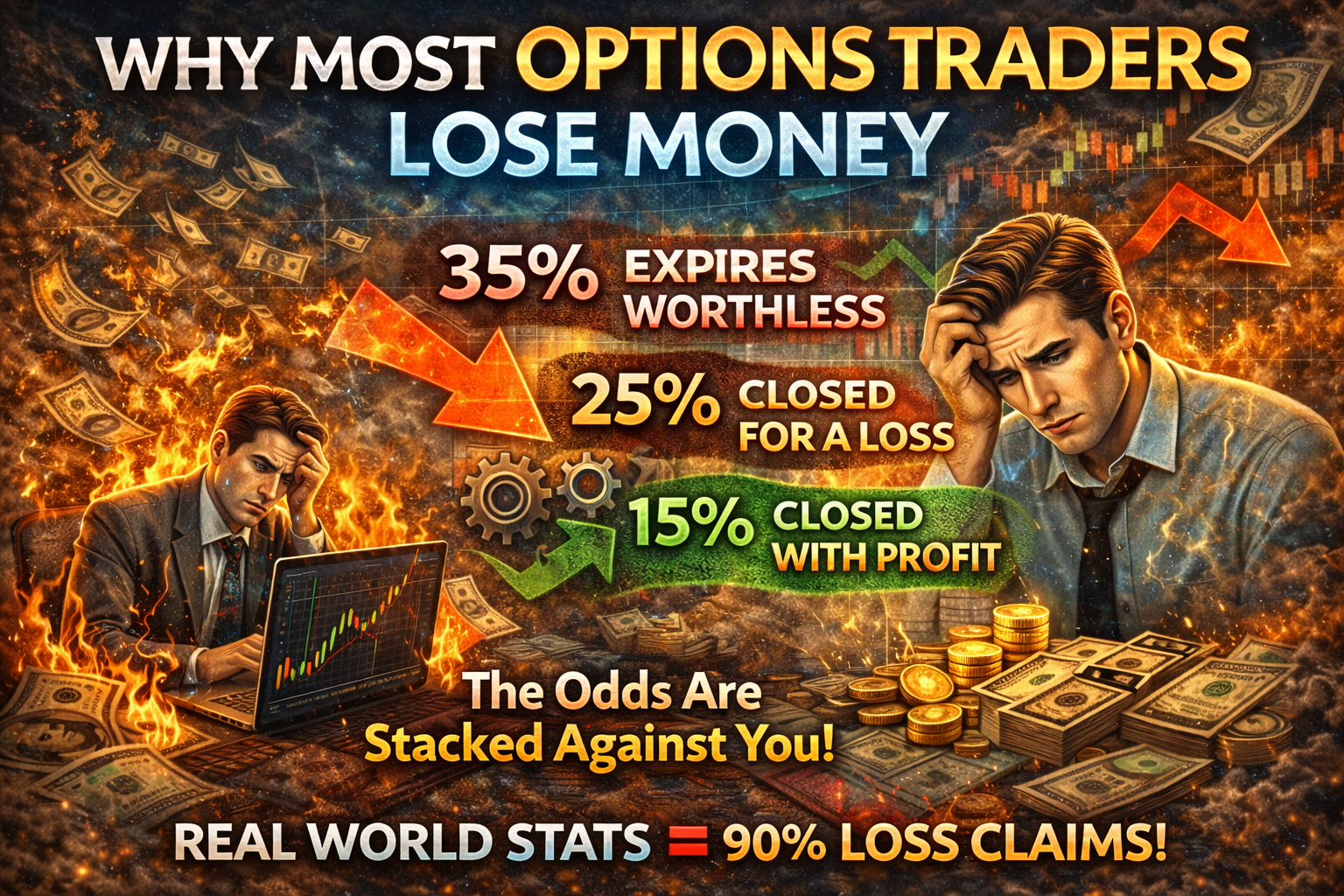
If roughly:
-
35% expire worthless
-
25% close for losses
-
15% close for profit
That means traders have a higher probability of losing everything on expiration than successfully closing a trade with profit.
In other words, the most likely outcome for many options trades is a complete loss of the premium paid.
That’s a brutal reality for traders who repeatedly buy options hoping for big wins.
Why Big Wins Are So Rare
Options are often marketed as a way to generate massive returns with small amounts of money.
And technically, that’s true.
Because options provide leverage, small price movements can produce large percentage gains.
A $200 option can sometimes turn into $2,000 if the stock moves sharply in the right direction.
But those situations are relatively rare.
Most stocks don’t make dramatic moves in short time periods.
Without a strong move in the correct direction, the option gradually loses value as expiration approaches.
This process is known as time decay, or theta.
Time Decay Is Always Working Against Buyers
Time decay is one of the most powerful forces in options pricing.
Every day that passes reduces the amount of time the option has to become profitable.
As expiration approaches, the option’s value erodes.
This means that even if the stock price stays exactly the same, the option still loses value over time.
For options buyers, time is always working against them.
For options sellers, time works in their favor.
That’s one reason many experienced traders prefer selling options rather than buying them.
Volatility Adds Another Challenge
Another factor that hurts many options buyers is volatility changes.
Options are heavily influenced by implied volatility, which represents the market’s expectations for future price movement.
When traders buy options before major events like earnings reports, volatility is often elevated.
After the event occurs, volatility frequently drops.
This phenomenon is called volatility crush.
Even if the stock moves in the expected direction, the option may still lose value because the volatility drop reduces the premium.
This surprises many new traders who don’t realize how volatility affects pricing.
The Psychology of Options Trading
The statistics alone don’t fully explain why so many traders lose money.
Psychology plays a major role as well.
Options trading often attracts people looking for fast profits.
Seeing screenshots online of someone turning $500 into $5,000 creates powerful emotional motivation.
But those posts rarely show the dozens of losing trades that occurred along the way.
This creates survivorship bias, where the successful trades get attention while the failures remain invisible.
As a result, new traders develop unrealistic expectations.
They believe large gains are common when they are actually rare.
Risk Concentration
Another issue is how traders allocate capital.
Because options require less money than buying shares, traders often take larger relative risks.
For example, someone with a $10,000 account might put $2,000 into a single options trade.
If the option expires worthless, that’s a 20% loss of the account.
Repeat that several times, and the account can disappear quickly.
Stock investors typically diversify their positions more carefully.
Options traders often concentrate risk into a few high-conviction trades.
That makes losses more severe when trades fail.
The Difference Between Buyers and Sellers
The statistics about options outcomes also reveal something important about market structure.
Options buyers face a constant uphill battle due to:
-
Time decay
-
Volatility changes
-
Expiration deadlines
Options sellers, on the other hand, benefit from these forces.
When options expire worthless, the seller keeps the entire premium.
That’s why many experienced traders use strategies like:
-
Covered calls
-
Cash-secured puts
-
Credit spreads
These strategies take advantage of the fact that many options eventually lose value.
Why Most Traders Still Try
Despite the difficult odds, options trading remains extremely popular.
Part of the reason is that the potential rewards are dramatic.
Even though most trades may lose money, the occasional big win can be very large.
This creates a lottery-like dynamic.
Many traders continue chasing those big payoffs, even if the long-term odds are not in their favor.
The excitement of the possibility keeps people coming back.
The Bottom Line
Options trading can be a powerful financial tool when used carefully and strategically.
But the reality for most traders—especially those buying calls and puts—is that the odds are challenging.
According to exchange statistics, roughly:
-
30–40% of options expire worthless
-
20–30% are closed for losses
-
20–30% are closed for profits
-
About 10% are exercised
Even though the often-quoted claim that 90% expire worthless is exaggerated, the numbers still show that losing money is common.
In fact, traders have a higher probability of losing their entire investment to expiration than successfully closing a trade for profit.
Options buyers must overcome time decay, volatility changes, and expiration deadlines—all of which work against them.
For many traders, those forces eventually add up.
And that’s why, despite the occasional success stories that dominate social media, the majority of options traders ultimately find themselves on the losing side of the trade.

Understanding the Greeks in Stock Options: The Hidden Forces That Control Option Prices

The Wheel Strategy: One of the Most Reliable Income Strategies in Options Trading

Cash Secured Puts: The Strategy That Feels Like an Ultra-High Yield Savings Account
About The Author
