The Truth About Social Media Stock “Picks”: Why the Loudest Voices Are Usually Trapped
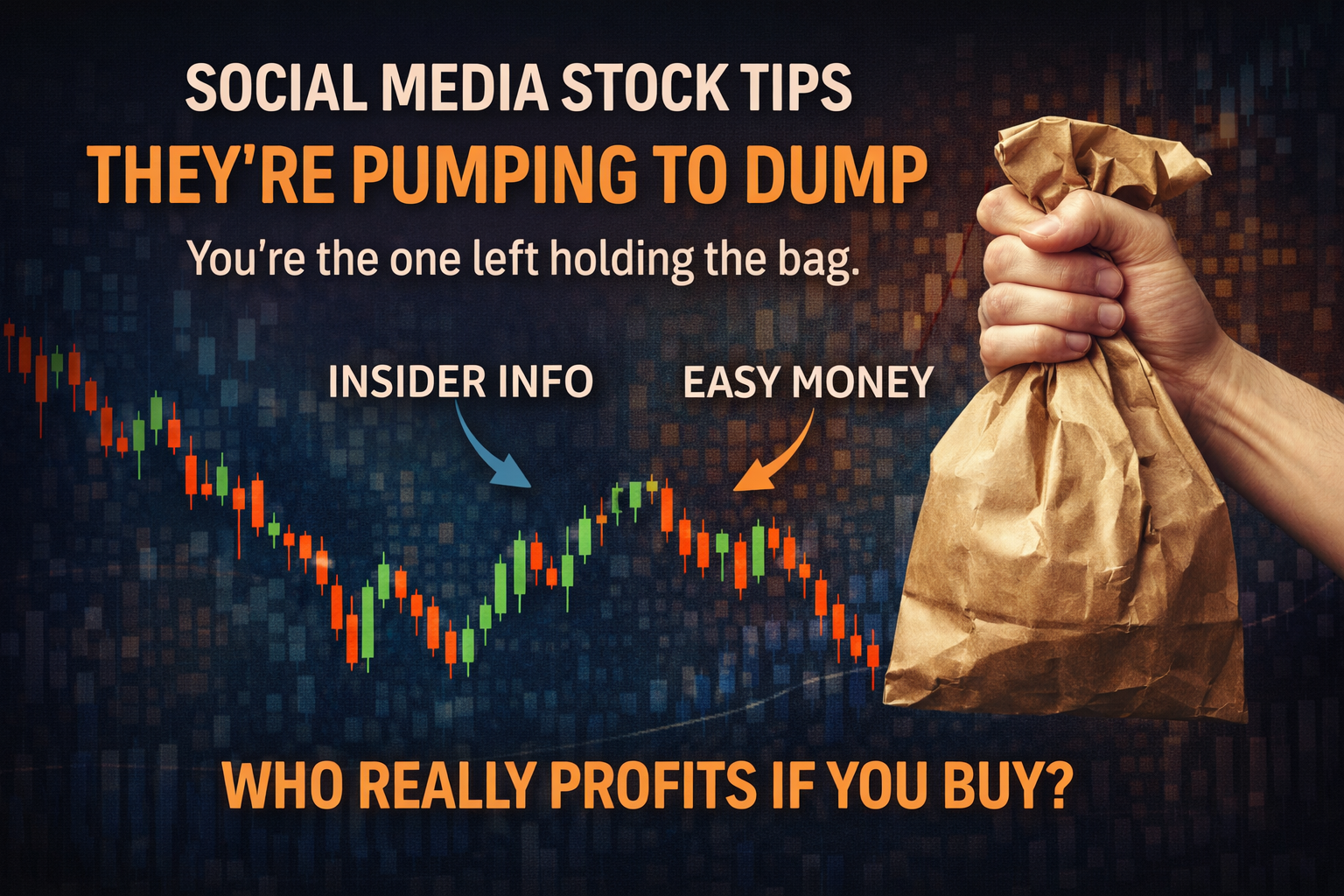 Scroll through social media long enough and you’ll inevitably see it.
A random account—sometimes anonymous, sometimes styled like a “trader brand”—starts aggressively pushing a stock you’ve never heard of. The posts are confident. Urgent. Loaded with charts, buzzwords, and bold claims:
-
“This is about to explode 🚀”
-
“Massive breakout incoming”
-
“Smart money is loading here”
-
“Don’t miss this one”
If you’re new to trading, or even just curious, it can feel compelling. You start wondering:
What if they’re right? What if I’m early? What if this is the opportunity I’ve been waiting for?
But here’s the reality that almost nobody on those platforms will tell you:
They’re not sharing an opportunity—they’re trying to escape one.
The Psychology Behind the “Hot Stock Tip”
To understand what’s really going on, you have to start with human behavior.
Imagine someone buys a small, low-volume stock. Maybe it looked promising. Maybe it had a little momentum. Maybe they just took a shot.
Then one of two things happens:
-
The stock goes nowhere
-
Or worse, it starts going down
Now they’re stuck.
There’s not enough volume to exit easily. Every time they try to sell, the price drops further. There aren’t enough buyers to absorb their position.
So what do they do?
They turn to the only tool they have left:
Attention.
Liquidity: The Part Nobody Talks About
The key issue in most of these situations is liquidity.
Large, well-known stocks:
-
Have constant buyers and sellers
-
Allow you to enter and exit easily
But small, obscure stocks?
-
Thin volume
-
Wide spreads
-
Limited buyers
That means:
-
Getting in is easy
-
Getting out is hard
And that’s where the problem begins.
If you hold a position in a low-liquidity stock:
-
You can’t just “click sell” and exit cleanly
-
Your own selling pressure pushes the price down
So instead of selling quietly…
You try to create buyers.
The Real Motivation Behind the Hype
When someone is aggressively promoting a no-name stock online, ask yourself:
What do they gain from you buying it?
Because they’re not doing it for your benefit.
They’re doing it because:
-
They already own it
-
They need liquidity
-
They want price to move up
Every new buyer:
-
Helps push the price higher
-
Gives them an opportunity to sell into that demand
In other words:
You become their exit strategy.
“It’s About to Break Out” — The Illusion of Certainty
One of the most common tactics is presenting charts as if they prove something.
You’ll see:
-
Trend lines
-
“Breakout zones”
-
Support levels
-
Arrows pointing upward
And the explanation will sound convincing:
“If it breaks this level, it’s going to run.”
But here’s the problem:
Everything looks obvious after the fact.
In real time:
-
That “breakout level” is uncertain
-
That “support” can fail instantly
-
That “setup” might never trigger
What you’re seeing isn’t prediction—it’s framing.
They’re taking normal, ambiguous price action and presenting it as inevitable.
The Volume Problem
Low-volume stocks are especially vulnerable to this behavior.
Because:
-
It doesn’t take much buying to move the price
-
Even small interest can create a spike
So what happens?
-
The stock is quiet, barely moving
-
Someone starts promoting it
-
New traders pile in
-
Volume increases
-
Price jumps
It looks like the original person was “right.”
But what actually happened?
The promotion created the move.
The Pump Phase
This is where things get dangerous.
As more people see the stock:
-
More buyers come in
-
Price accelerates
-
Excitement builds
Now the narrative shifts:
-
“See? Told you.”
-
“This is just getting started.”
-
“Still early.”
But behind the scenes, something else is happening:
The original promoters are selling.
They’re not adding. They’re not holding for the long term.
They’re exiting into the demand they created.
The Dump Phase
Eventually:
-
Buying slows down
-
Early promoters have sold
-
There’s no real demand left
And the stock drops.
Fast.
Now the same people who were hyping it might:
-
Go quiet
-
Move on to another stock
-
Or claim “it’s just a pullback”
Meanwhile, new buyers are stuck.
Holding a position in:
-
A low-volume stock
-
With declining interest
-
And limited exit options
The cycle repeats.
Why This Works So Often
You might wonder:
If this is so obvious, why do people keep falling for it?
Because it plays on powerful emotions.
1. Fear of Missing Out (FOMO)
When you see a stock moving:
-
You don’t want to be left behind
-
You feel like you’re late—but not too late
That urgency overrides logic.
2. Social Proof
If multiple people are talking about it:
-
It feels validated
-
It feels like “something is happening”
Even if all those voices are just echoing each other.
3. The Promise of Easy Money
Deep down, everyone wants:
-
A quick win
-
A big move
-
A shortcut
These posts tap directly into that desire.
The “Insider Info” Myth
Another common angle is the suggestion that:
-
“Something big is coming”
-
“News hasn’t hit yet”
-
“Smart money is accumulating”
This creates the illusion of insider knowledge.
But think about it logically:
If someone truly had:
-
Real insider information
-
A guaranteed catalyst
-
A high-probability move
Why would they:
-
Post it publicly
-
Share it with strangers
-
Create competition for their own trade
They wouldn’t.
Because real edges are:
-
Protected
-
Quiet
-
Not broadcast to the internet
The Bagholder Reality
At the core of all this is one simple truth:
Most of these promoters are bagholders.
They:
-
Bought too early
-
Bought the wrong stock
-
Got stuck in low liquidity
And now they’re trying to:
-
Generate interest
-
Create momentum
-
Exit without taking a loss
It’s not strategy.
It’s damage control.
The Aftermath for New Traders
If you buy into these situations, you often end up:
-
Buying near the top
-
Watching the price fade
-
Holding something with no liquidity
Then you face the same problem they did:
You can’t exit without:
-
Taking a loss
-
Or pushing the price down further
And that’s how the cycle continues.
How to Spot These Situations
While not every social media post is malicious, there are clear warning signs:
-
Obscure, low-volume stocks
-
Overly confident language
-
Urgency (“get in now”)
-
Lack of real fundamentals
-
Heavy reliance on charts without context
-
Repeated posting across multiple platforms
If it feels like marketing, it probably is.
What Real Opportunities Look Like
Real trading opportunities don’t look like:
-
Hype
-
Urgency
-
Constant promotion
They look like:
-
Structure
-
Patience
-
Clear risk management
They don’t require:
-
Convincing others
-
Creating demand
-
Posting nonstop about them
Because they stand on their own.
The Hard Truth
The market doesn’t need your help.
If a stock is truly:
-
Valuable
-
In demand
-
Positioned to move
It will:
-
Attract buyers naturally
-
Move with or without social media
If it needs to be promoted constantly…
That’s a red flag.
Final Thoughts: Don’t Be the Exit Liquidity
At the end of the day, trading is already difficult.
You’re dealing with:
-
Uncertainty
-
Competition
-
Constant decision-making
The last thing you need is to become part of someone else’s exit plan.
So the next time you see:
-
A random stock being hyped
-
Aggressive promotion
-
Claims of “easy money”
Take a step back and ask:
Who benefits if I buy this?
Because in many cases, the answer is simple:
Not you.
And once you understand that, you stop chasing noise—and start making decisions that actually work in your favor.