Don’t Panic the First Week: Why Big Early Losses in Covered Calls and Cash-Secured Puts Are Often Misleading
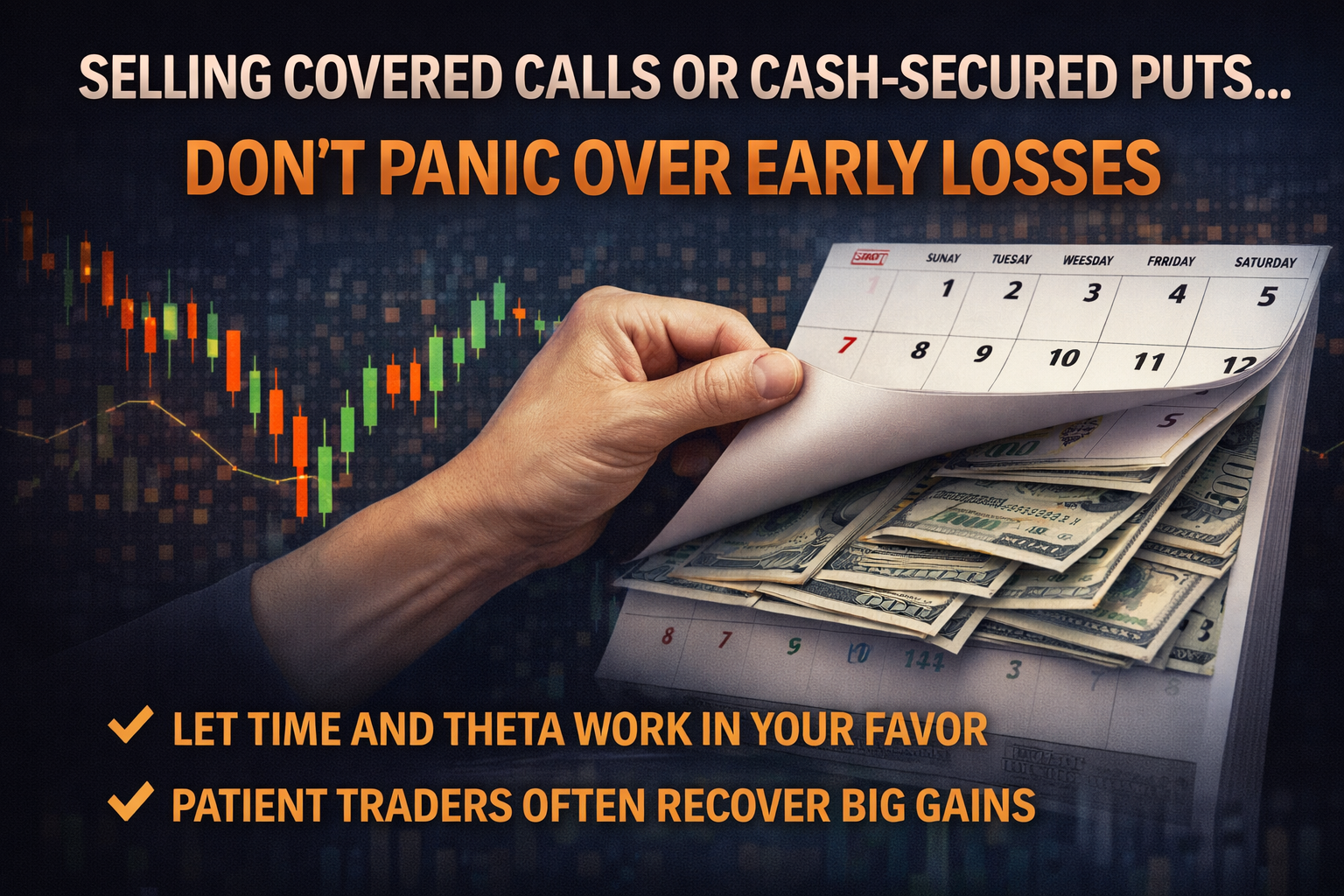 There’s a moment that almost every options seller experiences.
You open a trade—maybe a covered call or a cash-secured put. You felt good about it. The setup made sense. You gave yourself time, picked a reasonable strike, and collected your premium.
Then a few days later, you check your account…
And you’re down a lot.
Not a little. Not manageable. We’re talking:
-
Thousands of dollars
-
Red numbers everywhere
-
The kind of drop that makes your stomach tighten
Your first instinct?
“I need to get out of this right now.”
But here’s the reality most traders learn the hard way:
That early loss often doesn’t mean what you think it means.
In fact, in many cases, it’s completely normal—and exiting right there can turn a temporary drawdown into a permanent mistake.
Understanding What You Actually Sold
When you sell:
-
A cash-secured put → you’re agreeing to buy shares at a lower price
-
A covered call → you’re agreeing to sell shares at a higher price
In both cases, you’re selling time and probability.
You’re not betting on immediate price direction. You’re betting that:
-
Price won’t move too far against you
-
Time will pass
-
The option will lose value
That last part is key.
Because as an options seller, you benefit from theta decay—the gradual loss of value as expiration approaches.
Why Option Prices Can Spike Against You Early
Here’s where most people panic.
You enter a position, and within days:
-
The stock moves against you
-
The option price increases dramatically
-
Your unrealized loss balloons
For example:
-
You sell a put for $2.00
-
A few days later, it’s worth $5.00
-
Your account shows a large loss
But what changed?
Not time. Not expiration.
Just price movement and volatility.
Options are highly sensitive to:
-
Price changes (delta)
-
Implied volatility (vega)
-
Time (theta)
Early in a trade, price movement dominates.
That’s why losses can look so extreme so quickly.
The Key Mistake: Treating Unrealized Loss as Final
One of the biggest psychological traps in options selling is this:
You see a large red number and assume:
“This trade is failing.”
But what you’re looking at is:
-
A mark-to-market value
-
Based on current conditions
-
Not a final outcome
The option hasn’t expired.
Time is still working.
The trade is still alive.
Yet many traders:
-
Panic
-
Buy back the option
-
Lock in the loss
Not because the trade was invalid…
But because the temporary pain felt real.
Time Is Still on Your Side
If you entered the trade correctly—with:
-
30–45 days to expiration
-
Reasonable strike selection
-
Proper risk management
Then a few days of adverse movement doesn’t invalidate anything.
Because you still have:
-
Weeks of time decay
-
Opportunity for price to stabilize or rebound
-
A probability edge that hasn’t played out yet
This is the part many traders underestimate:
Options selling is a time-based strategy, not a day-to-day strategy.
The Role of Theta (Your Silent Advantage)
Theta is what you’re getting paid for.
Every day that passes:
-
The option loses value
-
Your position improves (all else equal)
Early in the trade:
-
Theta is relatively slow
As expiration approaches:
-
Theta accelerates
This means:
-
Even if the trade looks bad early
-
Time can gradually bring it back in your favor
Especially if price stabilizes or moves back toward your strike.
The Rebound Factor
Markets don’t move in straight lines.
Stocks:
-
Drop
-
Bounce
-
Consolidate
-
Reverse
If you panic during the initial move, you often miss:
-
The natural rebound
-
The stabilization phase
-
The decay that follows
This is where many traders make the same mistake:
They exit at the worst possible time.
A Common Scenario
Let’s walk through a realistic example.
You:
-
Sell a cash-secured put 30 days out
-
Collect a decent premium
-
Feel comfortable with the strike
A few days later:
-
The stock drops sharply
-
Your option value spikes
-
You’re down $2,000+ unrealized
You panic and close the trade.
Two days later:
-
The stock rebounds
-
Volatility drops
-
The option price collapses
Now that same position would have been:
-
Break-even
-
Or even profitable
But you’re already out—with a realized loss.
Why This Happens So Often
This pattern is incredibly common.
Because:
-
Early movement feels urgent
-
Losses feel real
-
Time feels irrelevant
But in options selling, it’s the opposite.
Time is the most important factor.
And early price movement is often just noise in the bigger picture.
The Importance of Trade Duration
If you’re selling options with:
-
Only a few days to expiration
Then yes—early movement matters more.
But if you’re selling:
-
30–45 days out
Then you’re giving yourself:
-
Flexibility
-
Time for recovery
-
Time for theta to work
That’s why many experienced traders prefer:
-
Selling further out
-
Managing the trade over time
Not reacting to every short-term move.
The Two-Week Rule of Breathing Room
A useful way to think about it:
If you still have 2+ weeks left in the trade:
-
The outcome is far from decided
There’s still:
-
Time for price to move
-
Time for volatility to drop
-
Time for decay to accelerate
Exiting early often ignores this entirely.
Fear vs. Strategy
When you exit early due to a large loss, ask yourself:
Are you:
-
Following your plan?
-
Or reacting emotionally?
Because most early exits are driven by:
-
Fear
-
Discomfort
-
Loss aversion
Not actual strategy breakdown.
The Illusion of “Cutting Losses Early”
In many areas of trading, cutting losses quickly is good.
But options selling is different.
Because:
-
The trade is designed to work over time
-
Early movement doesn’t define the outcome
-
The edge comes from probability and decay
Cutting early can:
-
Remove your edge
-
Lock in unnecessary losses
-
Turn normal volatility into permanent damage
When You Should Be Concerned
This doesn’t mean you should ignore everything.
There are situations where adjustment or exit makes sense:
-
The stock makes a major, sustained move against you
-
Your strike is deeply threatened
-
The trade no longer fits your risk tolerance
-
There’s a fundamental shift in the stock
But that’s different from:
-
A few days of volatility
-
A temporary spike in option value
The Psychological Battle
The hardest part of options selling isn’t strategy—it’s psychology.
Because you have to:
-
Sit through drawdowns
-
Trust the process
-
Ignore short-term noise
That’s uncomfortable.
But it’s also where the edge exists.
Most traders lose money not because their strategy is bad—but because:
-
They don’t give it time to work
Why Patience Pays
If you allow trades to play out:
-
Theta works in your favor
-
Price has time to normalize
-
Volatility often contracts
This combination can turn:
-
Large early losses
-
Into small losses
-
Or even profits
But only if you stay in the trade.
The Reality of Options Selling
Here’s the truth:
You will see:
-
Large unrealized losses
-
Sudden swings in value
-
Moments of doubt
That’s part of the strategy.
If you can’t tolerate that:
-
Options selling becomes very difficult
Because the edge requires:
-
Patience
-
Discipline
-
Emotional control
The Cost of Panic
Every time you exit early due to fear:
-
You realize a loss
-
You lose the chance for recovery
-
You reinforce emotional decision-making
Over time, this can:
-
Destroy profitability
-
Undermine your strategy
-
Keep you stuck in a cycle
The Bigger Picture
Options selling is not about:
-
Being right every day
-
Avoiding all losses
-
Perfect timing
It’s about:
-
Playing probabilities
-
Managing risk
-
Letting time work
Short-term pain is often part of that process.
Final Thoughts: Let the Trade Work
When you see a massive drop in option value early in a trade, it feels urgent.
It feels like something is wrong.
It feels like you need to act.
But most of the time, what you’re experiencing is:
-
Normal volatility
-
Temporary price movement
-
A trade that hasn’t had time to play out
If you’ve:
-
Chosen a good strike
-
Given yourself enough time
-
Managed your risk properly
Then the best move is often the hardest one:
Do nothing.
Let time pass.
Let theta work.
Let the stock breathe.
Because in many cases, the difference between:
-
A large loss
-
And a solid profit
Isn’t strategy.
It’s patience.
And the ability to not let fear make the decision for you.