Understanding the Greeks in Stock Options: The Hidden Forces That Control Option Prices
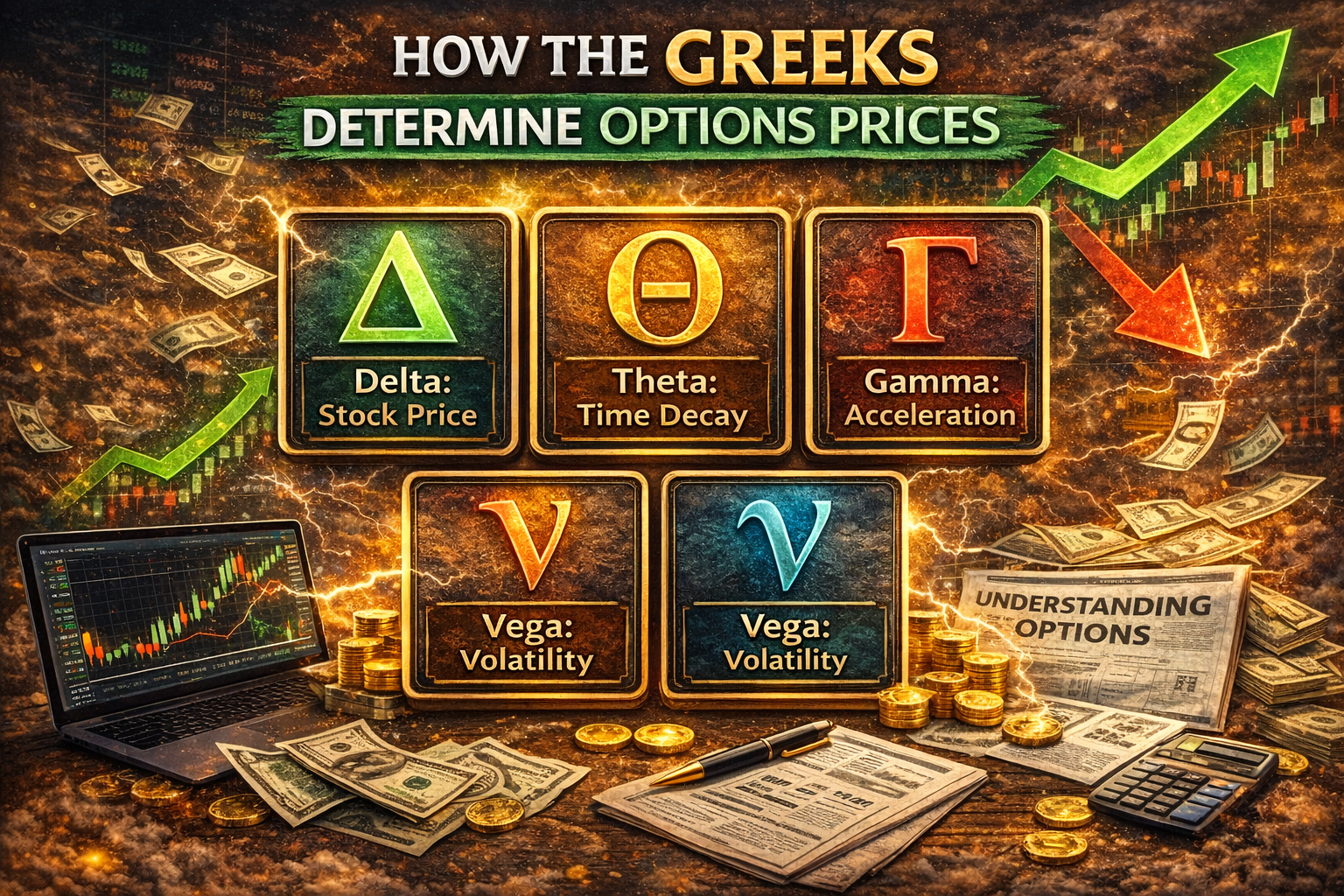 If you’ve ever looked at an options chain, you’ve probably seen a series of strange numbers labeled with Greek letters: Delta, Theta, Gamma, Vega, and sometimes Rho. To new options traders, these numbers often look confusing and overly technical. Many beginners ignore them entirely and focus only on strike prices and expiration dates.
That’s a mistake.
The Greeks are not just abstract mathematical concepts. They are the core mechanics that determine how options behave. If you trade options without understanding them, you’re essentially guessing how your position will react to changes in the market.
Options don’t move the same way stocks do. A stock might rise $5 and you make $5 per share. Options behave differently because their value depends on multiple factors: the stock price, time remaining until expiration, volatility, and interest rates.
The Greeks exist to measure how each of those factors affects the price of an option.
Once you understand the Greeks, the behavior of options starts to make much more sense.
Why the Greeks Exist
Options pricing is complicated because it depends on several moving parts simultaneously.
When the price of a stock changes, the value of an option changes. But so does the passage of time. So does market volatility. Even interest rates play a small role.
Instead of forcing traders to calculate these effects manually, the Greeks summarize how sensitive an option is to each factor.
Each Greek measures a different type of risk.
They tell you:
• How much the option price moves when the stock moves
• How fast the option loses value over time
• How volatility affects option pricing
• How sensitive the option is to acceleration in price movements
Think of them like a dashboard in a car. They don’t drive the car, but they tell you what’s happening under the hood.
Delta: How Much the Option Moves With the Stock
The most important Greek is Delta.
Delta measures how much an option’s price will change when the underlying stock moves by $1.
For example:
If a call option has a delta of 0.50, it means the option will increase by roughly $0.50 for every $1 increase in the stock price.
Likewise, if the stock falls by $1, the option will drop by about $0.50.
Delta helps traders understand how sensitive an option is to movements in the underlying stock.
Delta Ranges
Delta values fall into specific ranges depending on the type of option.
For call options, delta ranges from 0 to 1.
For put options, delta ranges from 0 to -1.
Examples:
• A call with a delta of 0.20 moves slowly with the stock
• A call with a delta of 0.80 moves strongly with the stock
• A put with a delta of -0.60 gains value as the stock falls
The closer the delta is to 1 or -1, the more the option behaves like the stock itself.
Delta and Probability
Delta is also often interpreted as the approximate probability that the option will expire in the money.
For example:
A call option with a delta of 0.30 roughly implies a 30% chance that it will finish in the money at expiration.
While this is not perfectly precise, traders frequently use delta as a probability estimate when constructing strategies.
Theta: The Silent Killer of Options
If Delta measures movement from stock price changes, Theta measures the passage of time.
Theta represents the amount an option loses in value each day due to time decay.
This is one of the most important forces in options trading.
Unlike stocks, options have expiration dates. As time passes, the opportunity for the option to become profitable decreases.
Because of that, options lose value gradually as expiration approaches.
How Theta Works
For example:
If an option has a theta of -0.05, it means the option loses $0.05 in value every day, all else being equal.
Over time, this decay adds up.
Even if the stock price stays completely unchanged, the option will slowly decline in value simply because time is running out.
This is why many options traders prefer selling options instead of buying them.
When you sell options, time decay works in your favor.
Theta Accelerates Near Expiration
One important detail about theta is that it accelerates as expiration approaches.
In the final weeks or days before expiration, time decay speeds up dramatically.
This is why short-term options often lose value very quickly.
For buyers, this can be frustrating.
For sellers, it can be extremely profitable.
Gamma: The Acceleration of Delta
Gamma measures how quickly delta itself changes.
If delta measures speed, gamma measures acceleration.
This might sound complicated, but the idea is simple.
When a stock moves, the option’s delta doesn’t stay constant. It changes depending on how close the option is to the strike price.
Gamma measures how rapidly that delta changes.
Why Gamma Matters
Options that are close to the strike price typically have the highest gamma.
That means their delta can change very quickly when the stock moves.
For example:
A call option with a delta of 0.50 might jump to 0.65 if the stock rises slightly.
That means the option will start moving faster with the stock.
This effect is why options near the strike price can become extremely volatile.
Gamma amplifies both gains and losses.
High Gamma = Higher Risk
High gamma environments often occur near expiration.
During these periods, options can swing wildly in price with small movements in the stock.
This can lead to rapid profits or losses.
Professional traders closely monitor gamma because it dramatically affects how positions behave during volatile markets.
Vega: The Power of Volatility
Another major factor affecting options pricing is volatility.
Volatility refers to how much a stock is expected to move over time.
Higher volatility increases the probability that an option will become profitable before expiration.
Because of this, higher volatility increases the price of options.
The Greek that measures this sensitivity is Vega.
What Vega Measures
Vega tells you how much the price of an option will change when implied volatility increases by 1%.
For example:
If an option has a vega of 0.10, it means the option will increase by $0.10 if implied volatility rises by 1%.
Conversely, if volatility drops, the option loses value.
Volatility Crush
One of the most famous examples of vega in action occurs around earnings announcements.
Before earnings, implied volatility often rises because traders expect large price movements.
After the announcement, volatility collapses.
This sudden drop in volatility is known as volatility crush.
Even if the stock moves in the correct direction, an option may still lose value if the volatility drop outweighs the price movement.
Rho: The Least Important Greek
The final Greek is Rho, which measures sensitivity to interest rates.
Rho tells you how much an option’s price changes when interest rates rise or fall.
In practice, Rho is usually the least important Greek for most traders.
Interest rates generally change slowly, and their impact on short-term options is relatively small.
However, Rho can become more relevant for long-term options such as LEAPS.
How the Greeks Work Together
The Greeks rarely act alone.
In real trading situations, multiple Greeks influence option prices simultaneously.
For example:
A stock may rise, increasing the option’s value due to delta.
At the same time, time decay may reduce the option’s value due to theta.
Meanwhile, volatility might change, adding or subtracting value through vega.
This combination of forces is what makes options pricing complex.
Understanding the Greeks allows traders to predict how these forces interact.
Why Options Sellers Love the Greeks
Many experienced options traders prefer selling options rather than buying them.
The Greeks explain why.
When you sell options:
• Theta works in your favor
• Volatility often decreases after events
• Many options expire worthless
Over time, these factors can give sellers a statistical edge.
That’s why strategies like covered calls and cash-secured puts are so popular.
They harness the power of time decay while limiting risk.
Why Beginners Often Ignore the Greeks
Many new options traders focus only on potential profits.
They see large percentage gains in option prices and assume it’s easy to replicate those returns.
But without understanding the Greeks, they don’t realize how quickly options can lose value.
For example:
A trader might buy a call option expecting a stock to rise.
The stock rises slightly, but not enough.
Meanwhile, theta decay erodes the option’s value.
Even though the stock moved in the expected direction, the trade still loses money.
This confuses many beginners.
But once you understand the Greeks, the outcome makes sense.
The Bottom Line
The Greeks are the foundation of options pricing.
They measure the forces that determine how an option behaves as market conditions change.
Delta tells you how much the option moves with the stock.
Theta shows how time decay erodes the option’s value.
Gamma measures how quickly delta changes.
Vega explains how volatility affects option prices.
Rho measures sensitivity to interest rates.
Together, these factors create the complex behavior that makes options both powerful and risky.
For traders willing to learn them, the Greeks transform options from mysterious contracts into predictable financial tools.
Ignoring them, however, is like flying a plane without looking at the instruments.
You might get lucky for a while.
But eventually, the forces you don’t understand will catch up with you.