The High Dividend Trap: Why Chasing Giant Yields Can Destroy Your Investment Through NAV Erosion
 Dividend investing has long been one of the most popular strategies in the stock market. The appeal is simple and easy to understand. Instead of relying entirely on stock prices going up, investors receive regular cash payments from their investments. Those payments can be reinvested to grow wealth or used as income.
Because of this, many investors begin searching for the highest dividend yields they can find. A stock paying 3–4% might seem decent, but when investors see funds or ETFs offering 10%, 12%, or even higher payouts, it can feel like they’ve discovered a gold mine.
But there’s a major problem with chasing giant dividends.
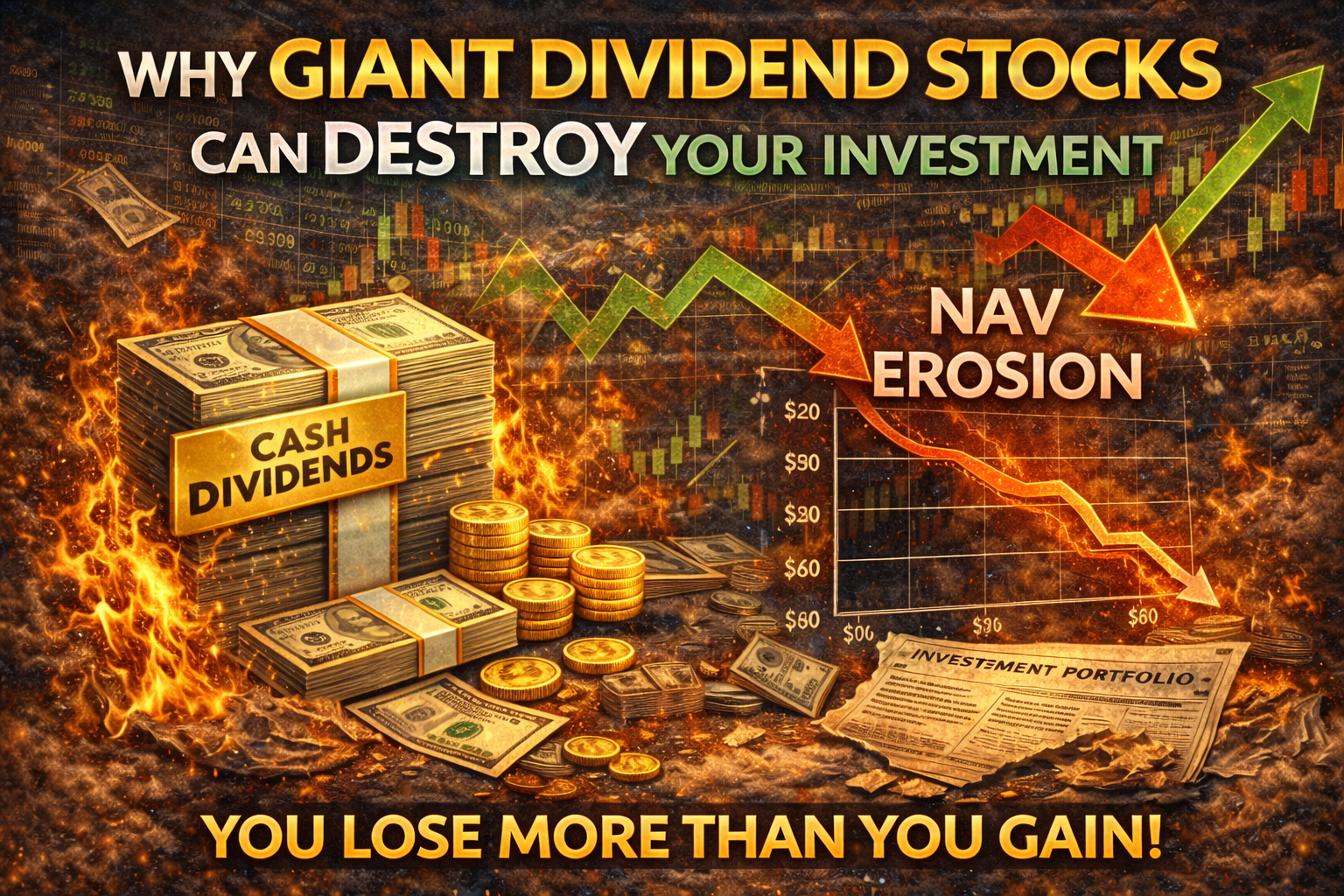
In many cases, those huge payouts come with a hidden cost: NAV erosion. Over time, the underlying value of the investment declines, quietly wiping out the gains investors thought they were making.
One of the clearest recent examples of this problem is the BITO ETF, which attracted investors with massive monthly dividends before its price steadily declined.
The lesson from BITO—and many similar investments—is simple: focusing only on yield can be financially dangerous.
Why High Dividend Yields Look So Attractive
The psychological appeal of dividends is powerful. When money appears in your account every month or quarter, it feels like your investments are actively working for you.
Consider two investments:
-
Investment A yields 3% annually
-
Investment B yields 12% annually
If you invest $100,000, the difference seems enormous.
Investment A produces about $3,000 per year.
Investment B produces $12,000 per year.
To many investors, the choice seems obvious. Why settle for a modest payout when you could earn four times as much?
But that comparison ignores one crucial question:
What is happening to the value of the investment itself?
Dividends don’t appear from thin air. They must come from the earnings, assets, or structure of the investment.
When dividends become extremely large, it often means the underlying value is being slowly drained.
Understanding NAV Erosion
NAV stands for Net Asset Value, which represents the total value of the assets held by a fund divided by the number of shares.
For ETFs and funds, NAV is essentially the true underlying value of the investment.
NAV erosion occurs when that value gradually declines over time.
This can happen for several reasons:
• The fund pays out more than it earns
• Assets are sold to fund dividends
• Management fees slowly drain value
• The investment strategy underperforms
• The fund structure requires distributions regardless of performance
When NAV falls, the share price eventually follows.
This means that while investors may receive impressive dividends, the total value of their holdings quietly shrinks.
The BITO Example
A very clear real-world example of this phenomenon can be seen in the ProShares Bitcoin Strategy ETF (BITO).
At one point, BITO became extremely popular among income-focused investors because it was paying massive monthly dividends.
There were periods when BITO paid around $1 per share per month in distributions.
At the time, BITO was trading around $20 per share.
That meant investors were seeing something that looked extraordinary: a stock paying roughly $12 per year on a $20 investment.
That’s a yield of about 60% annually, at least temporarily.
Naturally, income investors piled in.
But what happened next tells the real story.
Over time, the price of BITO declined significantly, eventually falling to around $9 per share.
And the large monthly dividends that attracted investors in the first place eventually stopped entirely.
So what happened to investors who bought the ETF for income?
Even though they may have collected dividends for a period of time, the value of their investment dropped dramatically.
A stock that falls from $20 to $9 loses 55% of its value.
That price decline can easily wipe out years of dividend income.
Why High-Yield ETFs Often Erode
Funds that produce extremely high dividends often rely on complex strategies to generate income.
In the case of BITO, the ETF doesn’t actually hold Bitcoin directly. Instead, it holds Bitcoin futures contracts.
Futures-based ETFs often suffer from a structural problem called roll cost, where contracts must be continuously replaced as they expire.
Over time, this can slowly erode the value of the fund.
When large dividends are paid on top of that, the erosion can accelerate.
This doesn’t mean the dividends were fake—but it does mean they weren’t sustainable.
The Illusion of Income
This is where many investors get caught in what’s called the dividend illusion.
When a large dividend hits your account, it feels like income.
But if the investment’s share price drops by the same amount—or more—you haven’t actually gained anything.
You’ve simply received part of your own capital back.
Imagine investing $10,000 into a fund that pays $1,200 per year in dividends.
If the fund’s value drops from $10,000 to $7,000 during that same period, your total wealth actually declined.
Even though you received income.
That’s the trap.
Return of Capital
Another issue with high-yield funds is return of capital.
Return of capital occurs when a fund distributes money that was not generated from profits or income.
Instead, the fund is effectively returning part of the investor’s own money.
This can happen when funds maintain high payouts even when performance doesn’t support it.
From the investor’s perspective, it still appears as a dividend.
But the underlying investment value continues to shrink.
Yield Can Rise As Price Falls
Another reason high dividend yields can be misleading is that yield is calculated using the formula:
Dividend ÷ Share Price
When the share price falls, the yield automatically increases.
For example:
If a stock pays $5 annually and trades at $100, the yield is 5%.
If the price drops to $50 but still pays $5, the yield becomes 10%.
To an investor searching for yield, that looks attractive.
But the falling price may actually signal financial problems.
Sometimes the market is already anticipating that the dividend will eventually be cut.
Total Return Is What Actually Matters
Experienced investors focus on something called total return.
Total return includes both:
• Dividends received
• Price appreciation (or depreciation)
A lower-yield investment that grows steadily can often outperform a high-yield investment whose price steadily declines.
For example:
Investment A yields 3% but grows 8% annually.
Total return: 11% per year
Investment B yields 12% but loses 7% in price annually.
Total return: 5% per year
Over time, that difference compounds dramatically.
The Psychological Trap of Monthly Income
Many investors fall into the dividend trap because of the psychological satisfaction of receiving regular payments.
Monthly dividends especially feel like income.
It’s easy to start focusing on the cash flow rather than the overall value of the investment.
But if the underlying asset is deteriorating, those payments may simply be masking a slow loss of capital.
BITO is a perfect example.
The huge dividends attracted investors, but the price decline ultimately erased much of the benefit.
Sustainable Dividends Look Different
Healthy dividend investments usually look very different from the high-yield funds that attract attention online.
Sustainable dividend stocks tend to have:
• Moderate yields (often 2–5%)
• Strong earnings growth
• Reasonable payout ratios
• Long histories of dividend increases
These companies generate income from real business performance rather than financial engineering.
Over time, investors benefit from both dividend growth and stock appreciation.
The Bottom Line
High dividend yields can be extremely tempting. The idea of earning large monthly payouts feels like an easy path to passive income.
But in many cases, those giant dividends come with a hidden cost: NAV erosion.
As the underlying value of the investment declines, the share price falls. Eventually, the losses in price can offset—or even exceed—the income received.
The story of BITO illustrates this clearly. Investors were attracted by monthly dividends approaching $1 per share when the ETF traded around $20. But as the price dropped toward $9 and the payouts stopped, many investors saw their gains evaporate.
That’s why experienced investors don’t focus on yield alone.
They focus on total return, sustainability, and the long-term health of the investment.
Because in the end, the biggest dividends in the market often come with the biggest hidden risks.