Emotional Discipline in Stock Trading: The Battle You Don’t See on the Charts
 There’s a moment every trader experiences, whether they admit it or not.
You’re in a trade. It starts going against you. Your stop loss is right there—clearly defined, planned ahead of time—but your finger hesitates. You think, “It’ll come back.” So you move the stop. Just a little. Then a little more.
Before you know it, what was supposed to be a small, controlled loss has turned into something much bigger.
That moment has nothing to do with strategy. Nothing to do with indicators. Nothing to do with the market.
That moment is emotional discipline—or the lack of it.
And in trading, emotional discipline is often the difference between surviving and blowing up your account.
What Emotional Discipline Really Means
Emotional discipline in trading is the ability to:
-
Follow your plan regardless of fear or greed
-
Accept losses without reacting impulsively
-
Stay consistent across wins and losses
-
Make decisions based on rules, not feelings
It sounds simple. It’s not.
Because trading isn’t just numbers on a screen. It’s your money. Your time. Your expectations. Your ego.
Every trade carries emotional weight, whether you realize it or not.
The Two Emotions That Control Everything
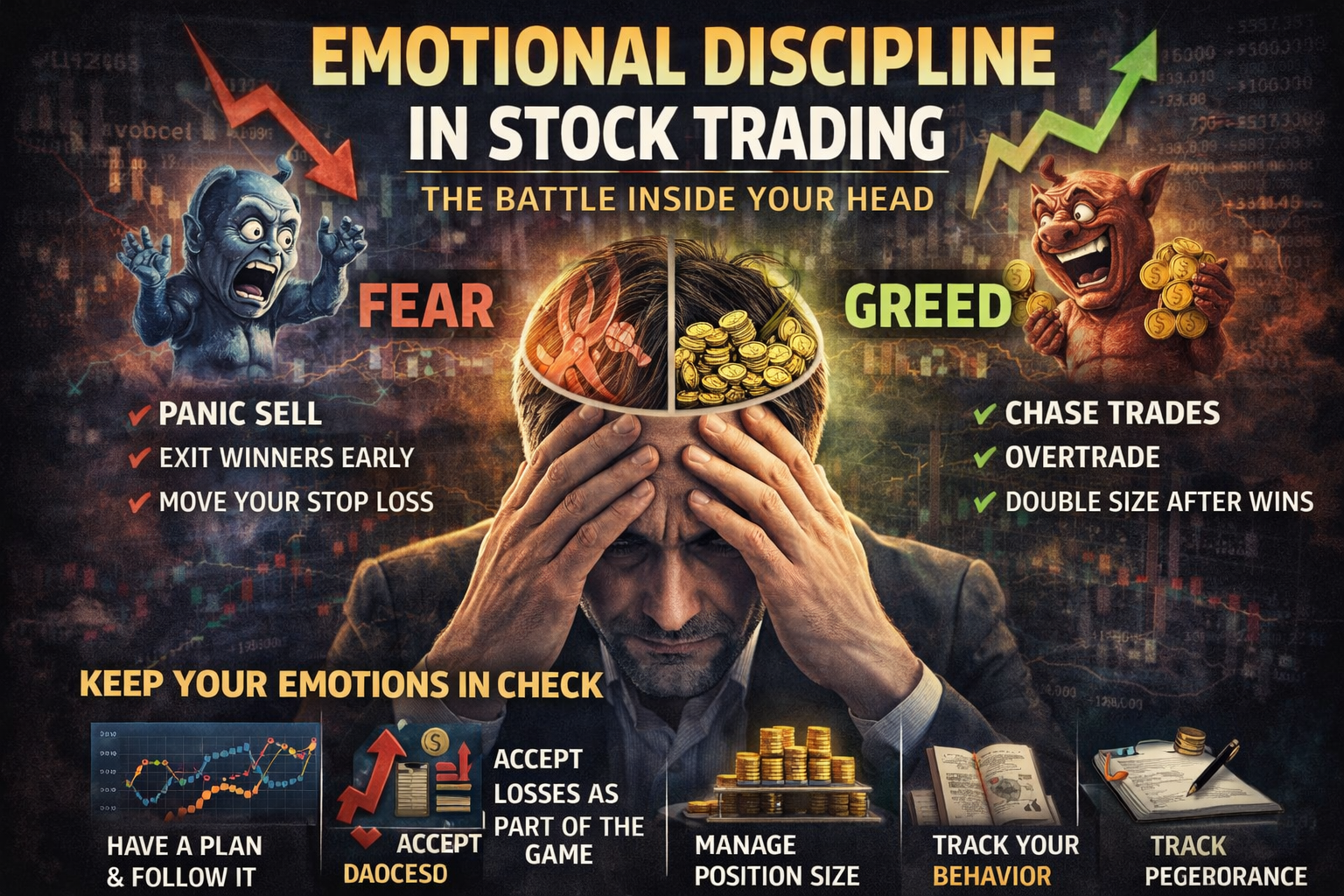
At the core of every bad trading decision are two emotions:
1. Fear
2. Greed
Everything else—panic, hesitation, overconfidence—branches out from those two.
Fear: The Silent Account Killer
Fear shows up in ways that feel logical in the moment:
-
You exit a winning trade too early because you’re afraid it will reverse
-
You hesitate to enter a good setup because you’re afraid of losing
-
You move your stop loss because you’re afraid of being wrong
Fear convinces you that you’re being cautious.
But in reality, it often leads to:
-
Missed opportunities
-
Inconsistent execution
-
Poor risk-to-reward outcomes
You end up cutting winners short and letting losers linger—exactly the opposite of what you should be doing.
Greed: The Other Side of the Same Coin
Greed is less subtle.
It shows up when:
-
You double your position size after a win
-
You hold a trade too long hoping for “just a little more”
-
You ignore your exit plan because the trade is working
Greed makes you feel invincible—until it doesn’t.
And when it turns, it usually takes your gains with it.
Why Emotions Are Stronger in Trading
Trading compresses emotional experiences into short bursts.
In everyday life:
-
Decisions play out over days, weeks, or years
In trading:
-
Decisions play out in minutes—or seconds
You can:
-
Gain money quickly
-
Lose money quickly
-
Be proven right or wrong instantly
That rapid feedback loop amplifies emotion.
It’s like putting your brain on fast-forward, where every decision feels urgent and every outcome feels personal.
The Illusion of Control
One of the biggest psychological traps in trading is the illusion that you can control outcomes.
You can:
-
Analyze charts
-
Study patterns
-
Build strategies
But you cannot control what the market does next.
That lack of control creates discomfort.
And the human brain doesn’t like uncertainty, so it tries to compensate by:
-
Overanalyzing
-
Overtrading
-
Forcing trades that aren’t there
Emotional discipline is about accepting that uncertainty—not fighting it.
The Most Common Emotional Mistakes
Let’s break down some of the most damaging behaviors traders fall into.
1. Revenge Trading
You take a loss. It stings. Instead of stepping back, you immediately enter another trade to “make it back.”
This is one of the fastest ways to spiral.
Why it happens:
-
You feel the need to recover
-
You want to prove you’re right
-
You’re reacting, not thinking
The result:
-
Lower-quality setups
-
Bigger losses
-
Emotional exhaustion
2. Overtrading
You feel like you always need to be in a trade.
No setup? No problem—you convince yourself there is one.
Why it happens:
-
Boredom
-
FOMO (fear of missing out)
-
Desire for action
The result:
-
Increased fees
-
Poor entries
-
Burnout
Sometimes the best trade is no trade at all—but that requires discipline.
3. Moving Stop Losses
This is one of the most common and destructive habits.
You enter a trade with a defined risk. Price approaches your stop. Instead of accepting the loss, you move it.
Why it happens:
-
You don’t want to be wrong
-
You believe the trade will “come back”
-
You’re avoiding emotional discomfort
The result:
-
Small losses turn into large ones
-
Risk management breaks down completely
4. Chasing Trades
You see a stock moving fast. You jump in late, afraid of missing out.
Why it happens:
-
Excitement
-
Social media hype
-
Seeing others “make money”
The result:
-
Poor entries
-
Bad risk-to-reward setups
-
Immediate drawdowns
5. Overconfidence After Wins
You hit a few good trades and start to feel like you’ve figured it out.
Why it happens:
-
Short-term success
-
Reinforcement of behavior
-
Ego
The result:
-
Larger position sizes
-
Increased risk
-
Bigger losses when things turn
The Role of Ego in Trading
Ego is one of the most underrated factors in trading.
You don’t just want to make money—you want to be right.
That desire leads to:
-
Holding losing trades too long
-
Ignoring new information
-
Refusing to exit when you should
The market doesn’t care if you’re right.
It doesn’t reward stubbornness. It doesn’t punish humility.
It simply moves.
Emotional discipline means detaching your identity from your trades.
A losing trade doesn’t mean you’re a bad trader.
It means the trade didn’t work.
That’s it.
Building Emotional Discipline
Emotional discipline isn’t something you’re born with. It’s something you build.
Here’s how.
1. Have a Clear Trading Plan
Before you enter any trade, you should know:
-
Your entry
-
Your stop loss
-
Your profit target
If you’re making decisions in real time, emotions will take over.
A plan gives you structure. Structure reduces emotional influence.
2. Accept Losses as Part of the Game
Losses are not failures—they’re expenses.
Just like any business has costs, trading has losses.
Once you truly accept that:
-
You stop fearing losses
-
You stop avoiding them
-
You start managing them
3. Reduce Position Size
If your trades feel emotionally overwhelming, your size is probably too big.
Smaller positions:
-
Reduce stress
-
Improve decision-making
-
Allow you to think clearly
You can’t be disciplined if every trade feels like a life-or-death decision.
4. Take Breaks After Big Wins or Losses
Emotions spike after extreme outcomes.
After a big win:
-
You feel invincible
After a big loss:
-
You feel desperate
Neither state is ideal for trading.
Stepping away helps reset your mindset.
5. Track Your Behavior, Not Just Your Trades
Most traders track profits and losses.
Few track:
-
Emotional decisions
-
Rule violations
-
Impulsive trades
Keeping a journal of your behavior helps you identify patterns—and fix them.
Discipline vs. Perfection
Here’s something important to understand:
You will not be perfectly disciplined all the time.
You will:
-
Break rules
-
Make emotional decisions
-
Have moments of weakness
That’s normal.
The goal isn’t perfection—it’s improvement.
It’s recognizing mistakes faster, correcting them sooner, and gradually building consistency.
Why Emotional Discipline Is the Real Edge
Strategies can be copied.
Indicators can be shared.
Information is everywhere.
But emotional discipline?
That’s personal.
That’s what determines whether you:
-
Follow your system
-
Stick to your risk management
-
Execute consistently
Two traders can use the exact same strategy and get completely different results—because one is disciplined and the other isn’t.
The Long-Term Perspective
Trading is not about what happens today, or this week, or even this month.
It’s about what happens over time.
Emotional discipline allows you to:
-
Stay consistent
-
Avoid catastrophic mistakes
-
Let your edge play out
Without it, even the best strategy will fail.
With it, even a simple strategy can work.
Final Thoughts: The Real Fight Isn’t the Market
Most people think trading is about beating the market.
It’s not.
It’s about managing yourself.
The charts don’t lie to you. Indicators don’t betray you. The market doesn’t target you personally.
But your emotions?
They will absolutely work against you if you let them.
So while others chase the perfect setup, the perfect indicator, or the perfect system, the real advantage comes from something much less exciting—and much more difficult:
Staying calm when things go wrong.
Staying disciplined when things go right.
And executing your plan no matter how you feel.
Because in the end, the most important trade you’ll ever manage…
Is the one happening in your own head.