Risk Management in Stock Trading: The Only Edge That Actually Matters
 There’s a hard truth about stock trading that most people don’t want to hear: success isn’t built on finding the perfect entry, predicting the next big move, or mastering some secret indicator. It’s built on risk management.
Not the flashy kind you see in YouTube thumbnails. Not the cherry-picked “perfect trade” examples. The real, often boring, discipline of controlling losses, managing position sizes, and surviving long enough to let probability work in your favor.
Because at the end of the day, trading isn’t about being right—it’s about not being wrong in a way that wipes you out.
What Risk Management Actually Means
Risk management is simply the process of controlling how much you can lose on any given trade, and across your portfolio as a whole.
It answers three critical questions:
-
How much am I willing to lose on this trade?
-
Where will I exit if I’m wrong?
-
How much capital should I commit?
Most beginners flip this completely upside down. They focus on:
-
“How much can I make?”
-
“Where’s the best entry?”
-
“How big should I go to maximize profit?”
That mindset is exactly what leads to blown accounts.
Professional traders think differently. They start with:
“How do I make sure one bad trade doesn’t matter?”
The First Rule: Never Risk Too Much on One Trade
One of the most common guidelines in trading is the 1–2% rule.
This means you should never risk more than 1–2% of your total account on a single trade.
For example:
-
Account size: $10,000
-
1% risk: $100
-
2% risk: $200
That means if your trade hits your stop loss, your maximum loss should fall within that range.
Why is this so important?
Because losing streaks happen. Even the best traders lose multiple trades in a row. If you’re risking 20–30% per trade, just a few losses can wipe you out completely.
But if you’re risking 1–2%:
-
5 losses = manageable
-
10 losses = still survivable
-
You live to trade another day
Risk management isn’t about winning—it’s about staying in the game.
Position Sizing: The Most Overlooked Skill
Position sizing is where risk management becomes real.
It’s not enough to say, “I’ll risk $100.” You need to calculate how many shares (or contracts) that actually translates into.
Let’s say:
-
You enter a stock at $50
-
Your stop loss is at $48
-
Risk per share = $2
If you want to risk $100 total:
-
$100 ÷ $2 = 50 shares
That’s your position size.
This is where most traders go wrong. They pick a position size first, then hope it works out. Instead, you should build your position size around your risk, not the other way around.
Stop Losses: Your Safety Net
A stop loss is your predefined exit point if a trade goes against you.
And no—“I’ll just watch it and decide” is not a strategy.
Without a stop loss:
-
Losses can spiral
-
Emotions take over
-
Small mistakes become large ones
A proper stop loss is:
-
Planned before entering the trade
-
Based on structure (support/resistance, volatility, etc.)
-
Non-negotiable once the trade is live
The key is consistency. You don’t move your stop just because you “feel” the trade will come back.
That’s not discipline—that’s hope.
The Role of Risk-to-Reward Ratios
You’ve probably heard of the 2:1 reward-to-risk ratio.
This means:
-
Risk $1 to potentially make $2
On paper, this sounds like a guaranteed edge. But it’s often misunderstood.
Here’s the reality:
-
A 2:1 ratio doesn’t guarantee success
-
It simply improves your math over time
If you:
-
Win 50% of your trades
-
Use a 2:1 ratio
You’ll likely be profitable.
But—and this is critical—the ratio only works if:
-
You actually stick to your stop loss
-
You actually take profits as planned
-
Your win rate isn’t significantly worse than expected
Most traders fail here because they:
-
Cut winners early
-
Let losers run
-
Break their own rules
Risk management isn’t just about setting ratios—it’s about executing them consistently.
The Emotional Side of Risk
This is where theory meets reality.
You can understand risk management perfectly on paper, but still fail in practice because of emotions.
Common emotional mistakes include:
1. Revenge Trading
After a loss, you immediately jump into another trade to “make it back.”
Result:
-
Poor decisions
-
Increased risk
-
Bigger losses
2. Overconfidence After Wins
You hit a few winners and start increasing position sizes.
Result:
-
One loss wipes out multiple gains
3. Moving Stop Losses
You don’t want to accept a loss, so you move your stop further away.
Result:
-
Small loss becomes a large one
4. Fear of Missing Out (FOMO)
You chase trades after they’ve already moved.
Result:
-
Bad entries
-
Poor risk-to-reward setups
Risk management is as much about controlling your behavior as it is about controlling your numbers.
Drawdowns: The Inevitable Reality
Every trader experiences drawdowns—a period where your account declines.
The question isn’t if it will happen. It’s how you handle it.
Good risk management ensures:
-
Drawdowns are controlled
-
Losses don’t compound exponentially
-
You have time to recover
For example:
If you lose:
-
10% of your account → you need ~11% to recover
-
25% → you need ~33%
-
50% → you need 100%
The deeper the loss, the harder it is to climb back.
This is why avoiding large losses is more important than chasing large gains.
Diversification: Not Putting All Your Eggs in One Basket
Another layer of risk management is diversification.
This doesn’t mean owning 50 random stocks. It means:
-
Not overexposing yourself to one position
-
Not putting your entire account into one idea
-
Spreading risk across different trades or sectors
If one trade fails, it shouldn’t significantly impact your entire portfolio.
Concentration might lead to big wins—but it also leads to big losses.
The Myth of “High-Probability” Setups
Many traders chase what they believe are “high-probability” setups.
The idea is:
“This trade looks perfect—it has to work.”
But no setup is guaranteed.
Even the best setups:
-
Fail regularly
-
Get invalidated by news
-
Break down unexpectedly
Risk management exists because uncertainty is unavoidable.
If every trade were predictable, you wouldn’t need stop losses or position sizing.
Why Most Traders Fail at Risk Management
It’s not because they don’t understand it.
It’s because they don’t respect it.
They:
-
Increase size after losses
-
Ignore stop losses
-
Trade emotionally
-
Focus on profits instead of risk
Risk management feels restrictive. It limits how much you can make on a single trade.
But that’s exactly the point.
It’s designed to protect you from yourself.
The Long Game: Thinking in Probabilities
Successful trading isn’t about individual trades—it’s about a series of trades over time.
Think of it like this:
-
Each trade is one outcome in a long sequence
-
Your edge plays out over dozens or hundreds of trades
Risk management ensures that:
-
No single trade dominates your results
-
Your edge has time to materialize
-
Random losses don’t derail your progress
Without it, even a good strategy can fail.
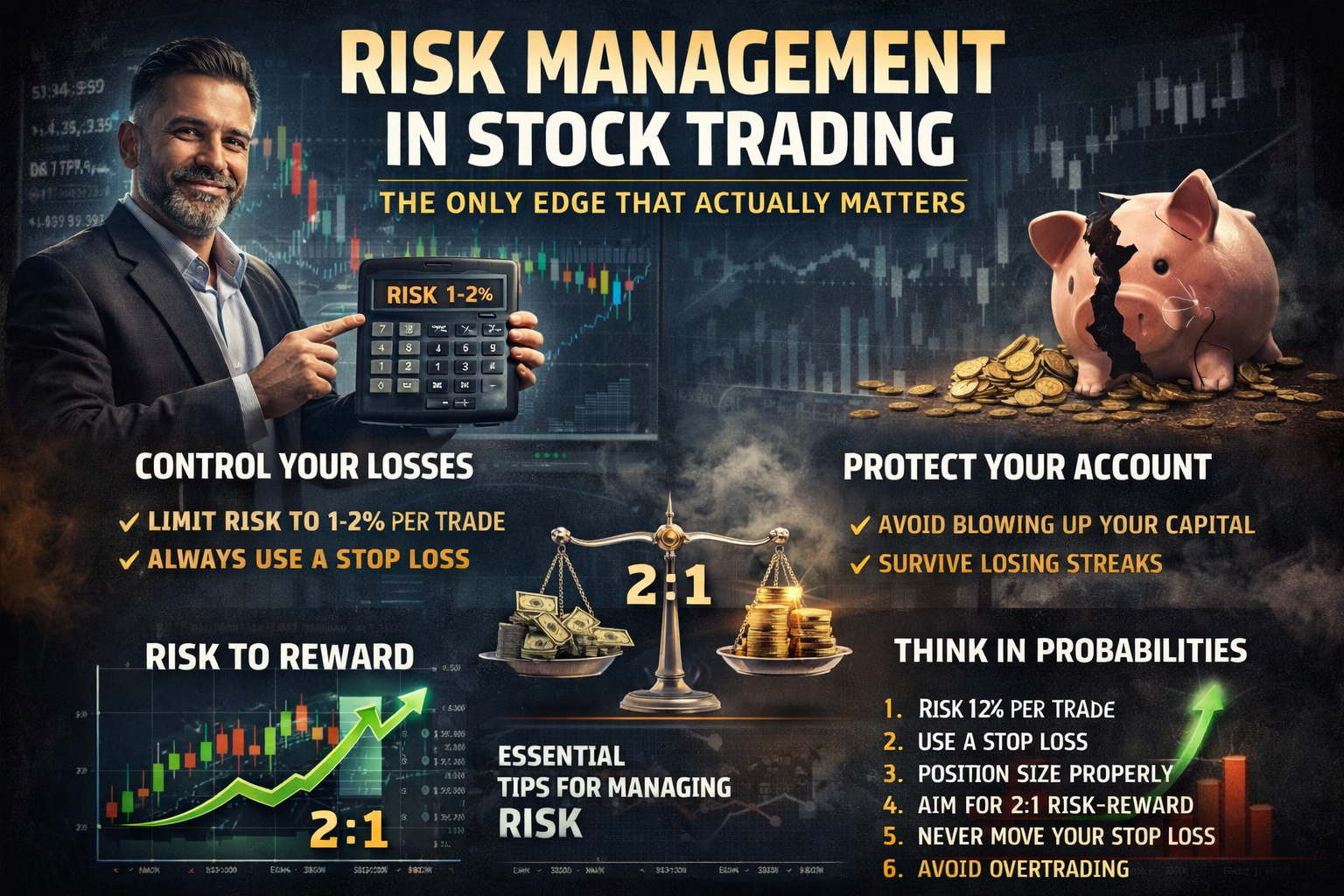
A Simple Risk Management Framework
If you want a practical starting point, keep it simple:
-
Risk 1–2% per trade
-
Always use a stop loss
-
Calculate position size based on risk
-
Aim for at least a 2:1 reward-to-risk ratio
-
Never move your stop loss further away
-
Avoid overtrading
-
Track your performance
You don’t need complexity. You need consistency.
The Bottom Line
Risk management isn’t exciting. It won’t make for flashy screenshots or viral posts. It doesn’t promise overnight success.
But it’s the one thing that separates traders who last from those who don’t.
Because the market doesn’t care:
-
How confident you are
-
How good your setup looks
-
How badly you want to win
It only responds to discipline.
And discipline, in trading, starts with managing risk.
So if you’re looking for an “edge,” stop searching for the perfect indicator or strategy.
You’ve already found it.
It’s not in predicting the market.
It’s in protecting yourself from it.