Consistency in Stock Trading: The Difference Between Luck and Longevity
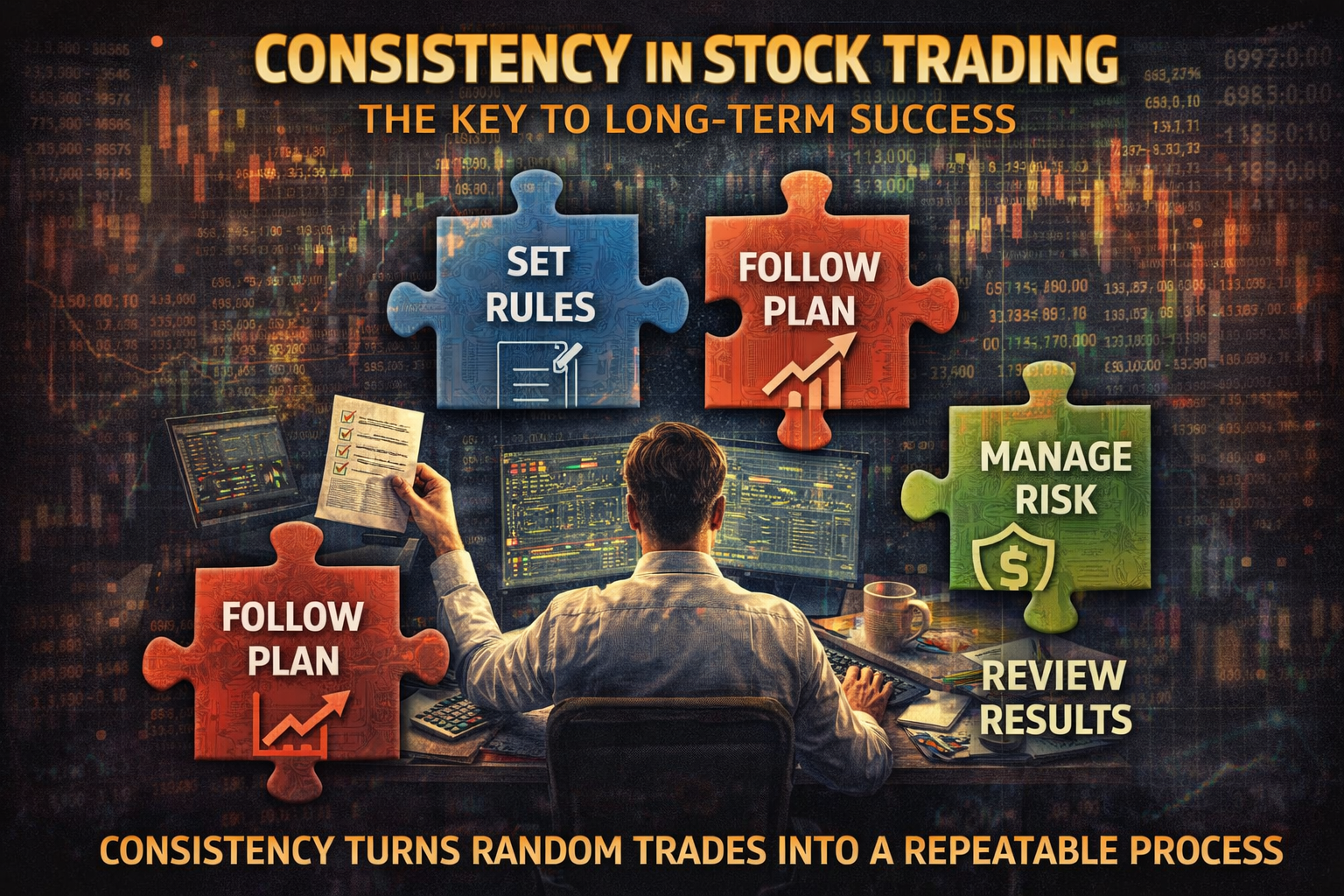 There’s a moment every trader chases.
A perfect trade. Clean setup. Smooth move. Profit hits exactly where you planned. It feels effortless—like you’ve finally figured it out.
And then the next trade loses.
Then another.
Then you change something. Then you chase something. Then suddenly, what felt like progress turns into confusion.
This cycle is incredibly common, and it all comes down to one missing piece:
Consistency.
Not consistency in profits every single day—that’s unrealistic. But consistency in process, execution, and decision-making. Because in trading, consistency is what turns random wins into a sustainable approach.
Without it, you’re not really trading—you’re just reacting.
What Consistency Actually Means
Consistency in trading isn’t about winning all the time. It’s about doing the same things, the same way, over and over again—regardless of recent outcomes.
It means:
-
Following your plan on every trade
-
Using the same risk management rules
-
Taking setups that meet your criteria—and ignoring those that don’t
-
Executing without hesitation or second-guessing
Consistency is process-driven, not result-driven.
And that’s where most traders get it wrong.
The Problem With Chasing Results
Most traders evaluate themselves based on outcomes.
-
“That was a good trade because I made money.”
-
“That was a bad trade because I lost.”
But that’s backwards.
A good trade is one where:
-
You followed your plan
-
You respected your risk
-
You executed correctly
Even if it loses.
And a bad trade is one where:
-
You broke your rules
-
You acted emotionally
-
You chased or forced a setup
Even if it wins.
If you judge yourself based on results alone, you reinforce bad habits and undermine good ones.
Consistency requires shifting your focus from:
“Did I make money?”
to
“Did I execute properly?”
Why Most Traders Struggle With Consistency
Consistency sounds simple. But in practice, it’s one of the hardest things to achieve.
Here’s why.
1. Strategy Hopping
You try one strategy. It works for a few trades. Then it doesn’t. So you switch.
Then you switch again.
And again.
The result:
-
No real data
-
No real edge
-
No consistency
Every strategy has losing streaks. If you abandon it every time it struggles, you never give it a chance to work.
2. Emotional Decision-Making
Even with a solid plan, emotions creep in.
-
You skip a trade because you’re afraid
-
You take an extra trade because you’re bored
-
You size up after a win or down after a loss
Each of these breaks consistency.
And small inconsistencies compound over time.
3. Lack of Clear Rules
If your plan is vague, your execution will be inconsistent.
For example:
-
“Enter on a good setup”
-
“Exit when it feels right”
That’s not a plan. That’s improvisation.
Consistency requires clarity.
You need defined rules for:
-
Entries
-
Exits
-
Risk
-
Position sizing
4. Overreaction to Short-Term Results
You have a bad week and assume something is wrong.
So you:
-
Adjust your strategy
-
Change your rules
-
Try something new
But short-term results don’t define long-term performance.
Consistency requires patience—something most traders struggle with.
The Power of Repetition
Consistency is built through repetition.
Doing the same thing, over and over, until it becomes second nature.
This is how:
-
Athletes train
-
Musicians practice
-
Professionals improve
Trading is no different.
When you repeat a process consistently:
-
You gather meaningful data
-
You identify strengths and weaknesses
-
You build confidence in your approach
Without repetition, everything feels random.
Building a Repeatable Process
If you want consistency, you need a process you can repeat.
At a minimum, that process should include:
1. Defined Entry Criteria
You should know exactly what qualifies as a trade.
Not “kind of looks good.”
But specific conditions like:
-
Price structure
-
Trend direction
-
Confirmation signals
If it doesn’t meet your criteria, you don’t take it.
2. Predefined Risk
Before entering a trade, you should know:
-
Where your stop loss is
-
How much you’re risking
-
Your position size
No guessing. No adjusting mid-trade.
3. Clear Exit Strategy
You should know:
-
Where you’ll take profits
-
When you’ll exit early (if needed)
This prevents emotional decisions in the moment.
4. Post-Trade Review
After each trade, ask:
-
Did I follow my plan?
-
What did I do well?
-
What can I improve?
This is where growth happens.
Consistency vs. Perfection
A common mistake is thinking consistency means perfection.
It doesn’t.
You will:
-
Miss trades
-
Make mistakes
-
Break rules occasionally
Consistency is about minimizing those moments—not eliminating them entirely.
It’s about improving over time.
The Role of Discipline
Consistency and discipline are closely tied.
Discipline is what allows you to:
-
Follow your plan when it’s uncomfortable
-
Stick to your rules when emotions are high
-
Execute without hesitation
Without discipline, consistency falls apart.
Because when things get difficult—and they will—your default behavior takes over.
The Impact of Inconsistency
Inconsistency doesn’t just affect your results—it affects your mindset.
When you’re inconsistent:
-
You don’t trust your strategy
-
You don’t trust your decisions
-
You feel like you’re guessing
This leads to:
-
Hesitation
-
Overthinking
-
Emotional trading
Consistency builds confidence. Inconsistency destroys it.
Thinking in Probabilities
Trading is a probability game.
No single trade matters. What matters is the outcome over many trades.
But probability only works if:
-
You execute consistently
-
You follow the same rules
If you change your behavior every trade, you:
-
Distort your results
-
Eliminate any statistical edge
Consistency is what allows probability to work in your favor.
The Long-Term Advantage
The goal in trading isn’t to have the best day, week, or even month.
It’s to build something sustainable.
Consistency allows you to:
-
Manage drawdowns
-
Maintain steady progress
-
Avoid catastrophic mistakes
It turns trading from a gamble into a process.
A Simple Framework for Consistency
If you’re struggling, simplify everything.
Focus on:
-
One strategy
-
One set of rules
-
One risk model
And commit to it for a meaningful period of time.
Track your results. Analyze your behavior. Make small adjustments—not constant overhauls.
The Truth About “Good” Traders
What separates good traders from struggling ones isn’t intelligence.
It’s consistency.
Good traders:
-
Do the same things repeatedly
-
Stick to their plan
-
Manage risk consistently
-
Stay emotionally stable
They don’t chase every opportunity. They don’t reinvent their strategy every week.
They focus on execution.
Final Thoughts: The Quiet Edge
Consistency isn’t exciting.
It doesn’t produce viral screenshots or massive one-day gains. It doesn’t feel like you’re “cracking the code.”
But it’s the foundation of everything that works in trading.
Because without it:
-
Strategies don’t matter
-
Risk management doesn’t matter
-
Experience doesn’t matter
Everything becomes random.
With it:
-
Even simple strategies can work
-
Even average setups can produce results
-
Even imperfect traders can succeed
So while others chase the next big move, the next indicator, or the next “perfect” system, the real edge comes from something much simpler—and much harder:
Showing up.
Following your plan.
And doing it the same way, every single time.
Because in trading, consistency isn’t just important.
It’s everything.