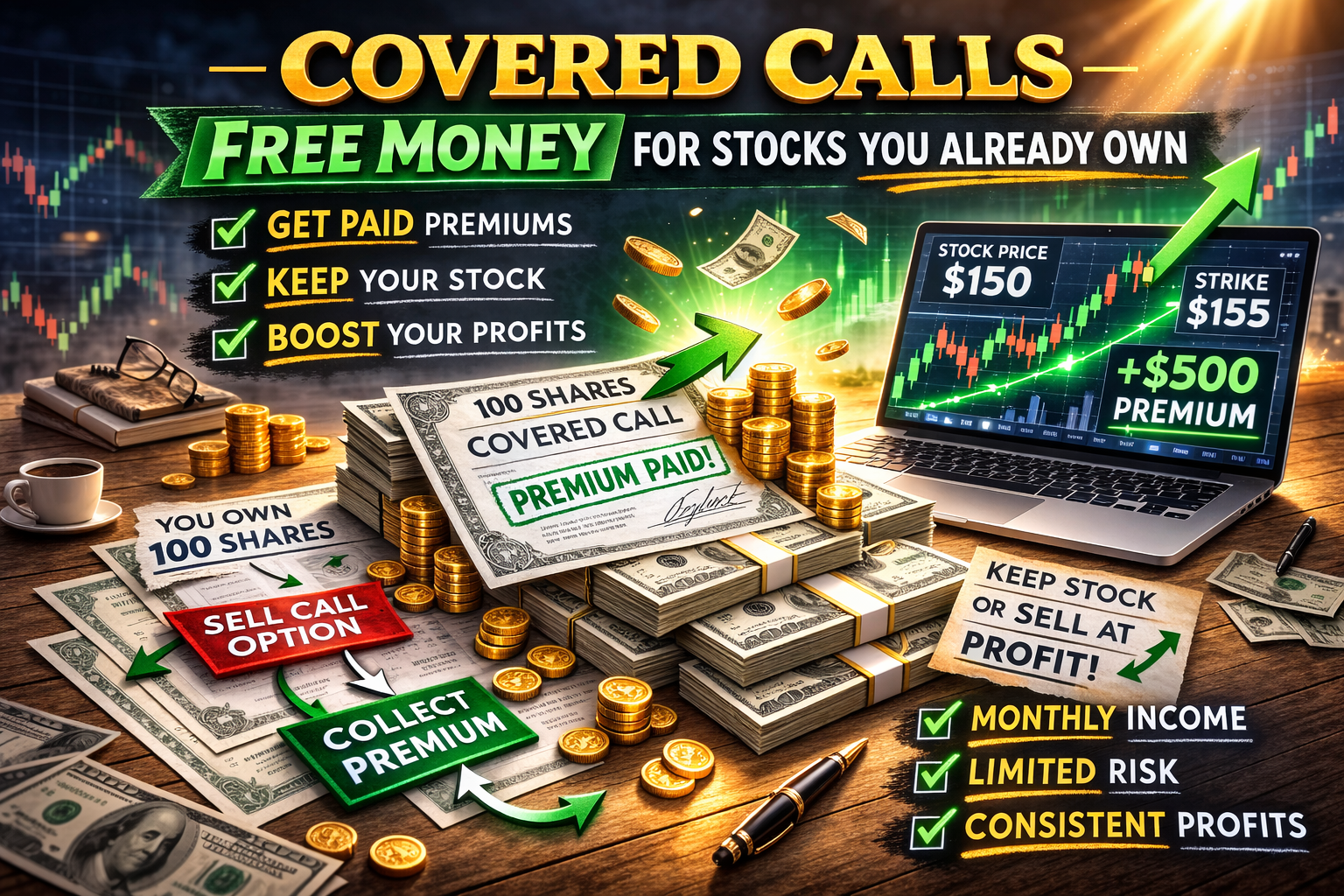
Covered Calls: Why Selling Options on Stocks You Already Own Can Feel Like Free Money
 In the world of investing, there are countless strategies promising higher returns, lower risk, or some kind of hidden market edge. Many of them are complicated, involving complex trading systems, endless chart analysis, and constant monitoring of the market.
But every once in a while, an investment strategy comes along that is both simple and surprisingly effective.
One of the most popular examples is the covered call.
For investors who already own stocks, selling covered calls can feel almost like discovering a cheat code in the market. Instead of simply waiting for your stocks to rise in value, covered calls allow you to generate income from the shares you already own.
That’s why many investors describe them in the simplest possible terms:
Covered calls are basically free money.
Now, that phrase isn’t entirely literal. Nothing in the market is truly free, and there are trade-offs involved. But once you understand how covered calls work, it becomes clear why so many investors love them.
They turn a passive investment into something that can produce regular income, often without taking on significant additional risk.
What Is a Covered Call?
A covered call is an options strategy where an investor sells a call option against shares they already own.
Each options contract represents 100 shares of stock, so to sell one covered call you must own at least 100 shares of the underlying stock.
Here’s the basic idea:
-
You own 100 shares of a stock.
-
You sell a call option on that stock.
-
Someone pays you a premium for the right to buy your shares at a specific price (called the strike price) before a certain expiration date.
That premium is yours to keep immediately.
Whether the option expires worthless or the shares get called away, the premium is already in your pocket.
This is what makes covered calls so appealing. You’re generating income from stock you already own.
Why Covered Calls Feel Like Free Money
Imagine you own 100 shares of a stock trading at $100.
You decide to sell a call option with a strike price of $110, expiring in one month. For selling that option, you receive a $2 premium per share.
Since one contract covers 100 shares, that means you collect $200 immediately.
Now three things can happen.
Scenario 1: The Stock Stays Below $110
If the stock finishes below the strike price at expiration, the option expires worthless.
The buyer of the option never exercises their right to purchase the shares.
You keep your 100 shares and the $200 premium.
Then you can sell another call option the following month and collect another premium.
This is the scenario many covered call sellers hope for.
The stock moves sideways or rises slowly, allowing them to repeatedly collect option income.
Scenario 2: The Stock Rises Above $110
If the stock rises above the strike price, the option buyer may exercise the contract.
That means your shares are sold at the strike price of $110.
But here’s the important part: you still keep the $200 premium.
So your total profit becomes:
-
$10 gain per share from $100 to $110
-
Plus the $2 premium
Total profit: $12 per share
That’s $1,200 total profit on 100 shares.
Yes, the stock could keep rising after that, meaning you miss additional upside. But you still walk away with a solid gain.
Scenario 3: The Stock Drops
If the stock falls, the premium you collected acts as a small cushion against the loss.
For example, if the stock drops from $100 to $98, you technically lost $2 per share on the stock.
But the $2 premium offsets that loss.
In this case, you break even.
While covered calls don’t eliminate downside risk entirely, they do provide a small buffer.
Turning Stocks Into Income Machines
Many investors hold stocks for long-term growth.
They buy shares of strong companies and wait years for the price to appreciate.
Covered calls add another dimension to this strategy.
Instead of simply holding the stock, investors can generate consistent income while they wait.
This income can come from:
-
Monthly options
-
Weekly options
-
Quarterly options
Depending on the stock’s volatility and liquidity.
For stocks with active options markets, this income can add up quickly.
Some investors generate hundreds or even thousands of dollars per month selling covered calls against large positions.
Why High-Quality Stocks Work Best
Covered calls tend to work best with stocks you already want to own.
That’s why many investors use the strategy on large, stable companies.
Examples often include companies like:
-
Apple
-
Microsoft
-
Nvidia
-
Johnson & Johnson
-
Coca-Cola
Or large ETFs like:
-
S&P 500 funds
-
Nasdaq funds
-
Total market funds
These investments typically have strong liquidity in the options market and relatively predictable long-term growth.
The goal isn’t to gamble on risky stocks.
It’s to generate income from assets you would be comfortable holding anyway.
The Monthly Income Potential
One of the most attractive aspects of covered calls is how they can produce regular income.
Imagine owning 500 shares of a stock trading around $100.
If you sell five call contracts and collect $150 per contract, that’s $750 in income for the month.
If the options expire worthless, you keep the premium and still own the shares.
Then you can repeat the process again.
Over the course of a year, those monthly premiums can add up to thousands of dollars.
For investors with larger portfolios, the numbers can become even more impressive.
Why Options Buyers Often Lose
Another reason covered calls can be profitable is because options tend to decay over time.
This phenomenon is known as time decay, or theta.
Every day that passes brings the option closer to expiration.
If the stock price doesn’t move significantly, the value of the option gradually decreases.
That decline in value benefits the option seller.
In other words, time is working in your favor.
The buyer of the option needs a significant price move to make money.
The seller simply needs the stock to avoid large upward moves.
Covered Calls Favor the Seller
Options trading often resembles an insurance market.
The person buying the option is paying for protection or opportunity.
The seller is collecting that payment in exchange for accepting certain obligations.
In many cases, options are priced in a way that slightly favors the seller over the long term.
This is similar to how insurance companies operate.
Most policies expire without claims.
The premiums collected from many buyers generate profit for the seller.
Covered calls operate on a similar principle.
The Trade-Off: Limited Upside
Of course, covered calls aren’t perfect.
The biggest trade-off is that they cap your upside potential.
If the stock suddenly skyrockets far above the strike price, your shares will likely be called away.
You still keep the premium and the gain up to the strike price, but you miss any additional upside beyond that level.
For investors who expect explosive growth in a stock, selling covered calls might not be ideal.
But for investors focused on steady income, this trade-off is often acceptable.
Why Long-Term Investors Love Covered Calls
Many long-term investors embrace covered calls because they align with a practical mindset.
Instead of chasing unpredictable market moves, they focus on generating consistent income from assets they already own.
Covered calls can:
-
Boost portfolio income
-
Reduce volatility slightly
-
Provide a small downside cushion
-
Turn idle shares into income-producing assets
Over long periods of time, the accumulated premiums can significantly increase total returns.
Covered Calls and Retirement Income
For retirees or investors approaching retirement, covered calls can be especially useful.
A portfolio that produces income from:
-
Dividends
-
Interest
-
Option premiums
can provide regular cash flow without constantly selling shares.
This approach allows investors to maintain their positions while still generating spending money.
Some retirees even structure their portfolios specifically around income-producing strategies like covered calls.
The Simplicity of the Strategy
Despite being part of the options market, covered calls are actually one of the simplest options strategies available.
Unlike many complex spreads or speculative trades, covered calls are straightforward.
You already own the stock.
You sell a call option.
You collect the premium.
And you repeat the process if the option expires.
Many brokerages even have built-in tools that make selling covered calls extremely easy.
For investors willing to learn the basics of options, the strategy can be surprisingly accessible.
The Bottom Line
Covered calls occupy a unique place in the investing world.
They combine the stability of long-term stock ownership with the income potential of options trading.
By selling call options on shares you already own, you can collect premiums that add to your overall return.
While the strategy limits some upside potential, it offers something many investors value even more:
consistent income.
For stocks that might otherwise sit quietly in a portfolio, covered calls can transform them into regular cash generators.
That’s why so many investors come to the same conclusion once they understand how the strategy works.
Covered calls might not literally be free money.
But when used on stocks you already own and plan to hold anyway, they can come surprisingly close.