Realistic Expectations in Stock Trading: The Reality Most Traders Avoid
 There’s a version of trading that gets sold everywhere.
It’s fast. It’s exciting. It’s filled with screenshots of massive gains, perfectly timed entries, and captions that make it seem like money is just sitting there waiting to be taken.
Spend enough time around that world, and it starts to feel normal. You begin to think:
-
“Maybe I should be making this much.”
-
“Why am I not seeing results like that?”
-
“What am I missing?”
But here’s the truth most people don’t say out loud:
Those expectations are not reality.
And chasing them is one of the fastest ways to fail in trading.
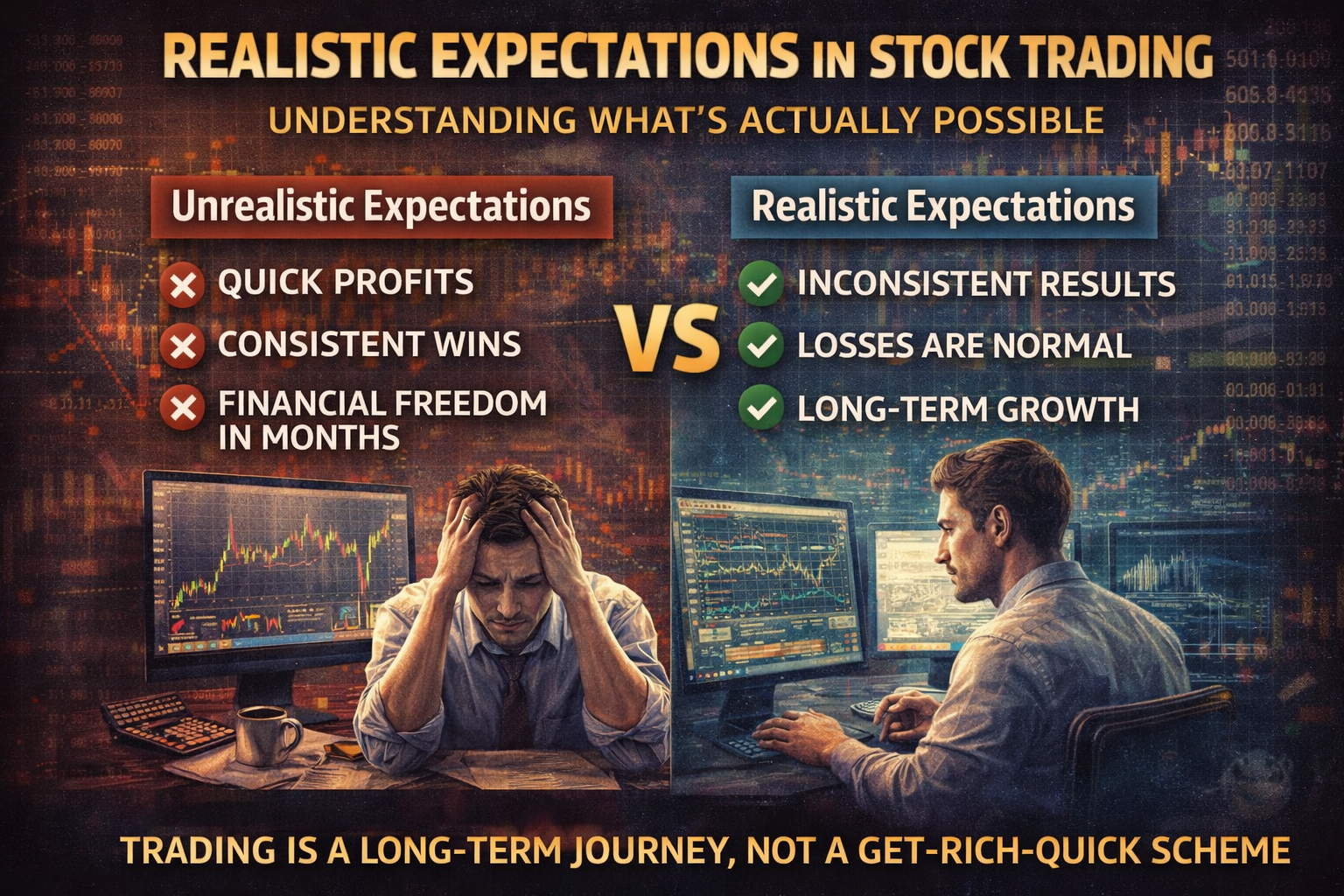
The Expectation Gap
One of the biggest problems new traders face is the gap between expectation and reality.
Expectation:
-
Quick profits
-
Consistent wins
-
Predictable outcomes
-
Financial freedom in months
Reality:
-
Inconsistent results
-
Frequent losses
-
Uncertainty
-
A long learning curve
That gap creates frustration. And frustration leads to bad decisions.
Because when your expectations are unrealistic, everything that happens feels like failure—even when you’re actually progressing.
The Myth of Fast Money
Social media has completely distorted how people view trading.
You see:
-
100% gains in a day
-
Options trades turning small accounts into big ones
-
“I turned $1,000 into $10,000” stories
What you don’t see:
-
The losses that came before
-
The blown accounts
-
The risk taken to get there
Those big wins are real—but they’re not sustainable.
They’re often:
-
High-risk trades
-
Low-probability outcomes
-
Short-term luck
Trying to replicate that consistently is like trying to win the lottery every week.
Trading Is Not Linear
Another unrealistic expectation is the idea that progress should be steady and upward.
In reality, trading looks more like this:
-
Win
-
Loss
-
Loss
-
Win
-
Break-even
-
Win
-
Loss
It’s uneven. It’s unpredictable. It’s messy.
Even experienced traders go through:
-
Drawdowns
-
Cold streaks
-
Periods of doubt
If you expect smooth progress, you’ll constantly feel like something is wrong.
The Timeline Nobody Talks About
One of the most important things to understand is how long it actually takes to become consistently profitable.
For most people:
-
It takes months just to understand the basics
-
It takes years to develop consistency
That’s not because trading is impossible—it’s because it requires:
-
Experience
-
Emotional control
-
Pattern recognition
-
Discipline
These things don’t develop overnight.
But unrealistic expectations make people think they should.
The Cost of Unrealistic Expectations
When your expectations are too high, it affects everything.
1. Overtrading
You feel like you need to make money quickly, so you:
-
Take more trades
-
Force setups
-
Lower your standards
Result:
-
More losses
-
Less clarity
-
Burnout
2. Oversizing Positions
You want bigger returns, so you increase your position size.
Result:
-
Higher emotional pressure
-
Larger losses
-
Increased volatility in your account
3. Strategy Hopping
You expect immediate results. When they don’t come, you switch strategies.
Result:
-
No consistency
-
No real edge
-
Constant confusion
4. Emotional Instability
You expect success, so when losses happen, they hit harder.
Result:
-
Frustration
-
Impulsive decisions
-
Loss of confidence
What Realistic Expectations Look Like
If you want to succeed in trading, you need to recalibrate what “success” actually means.
1. Losses Are Normal
Even great traders lose regularly.
A realistic expectation is:
-
You will lose trades
-
You will have losing streaks
-
You will be wrong often
The goal is not to avoid losses—it’s to manage them.
2. Small Gains Add Up
Instead of chasing massive wins, focus on:
-
Consistent execution
-
Controlled risk
-
Gradual growth
Trading is not about hitting home runs. It’s about:
-
Singles
-
Doubles
-
Avoiding strikeouts
3. Progress Is Measured in Behavior
Real progress looks like:
-
Following your plan more consistently
-
Managing risk better
-
Controlling emotions
Not just making money.
4. Break-Even Is a Milestone
Most traders underestimate how important break-even performance is.
If you can:
-
Trade consistently
-
Manage risk
-
Avoid large losses
And end up around break-even, that’s progress.
It means you’re close.
The Role of Patience
Patience is one of the most underrated traits in trading.
Not just patience in waiting for setups—but patience in:
-
Learning
-
Improving
-
Letting results develop over time
Unrealistic expectations destroy patience.
They make you feel like:
-
You’re behind
-
You’re failing
-
You need to rush
But trading doesn’t reward urgency.
It rewards discipline over time.
Understanding Your Edge
Another key part of realistic expectations is understanding what an “edge” actually looks like.
An edge is not:
-
Winning every trade
-
Predicting the market perfectly
An edge is:
-
A slight statistical advantage over many trades
That’s it.
It might look like:
-
A 55% win rate
-
A consistent risk-to-reward ratio
-
Controlled losses
That doesn’t sound exciting—but it’s real.
And over time, it’s enough.
Why Comparison Is Dangerous
One of the worst things you can do in trading is compare yourself to others.
Because you’re not seeing the full picture.
You’re seeing:
-
Their best trades
-
Their biggest wins
-
Their highlight moments
You’re not seeing:
-
Their losses
-
Their struggles
-
Their full journey
Comparison creates unrealistic expectations—and unrealistic expectations lead to poor decisions.
Building a Realistic Mindset
If you want to reset your expectations, focus on this:
1. Think in Years, Not Weeks
Trading is a long-term skill.
Approach it like:
-
Learning a profession
-
Developing expertise
-
Building experience
Not like a quick opportunity.
2. Focus on Process Over Profit
Ask yourself:
-
Did I follow my plan?
-
Did I manage risk properly?
-
Did I stay disciplined?
Instead of:
-
How much did I make?
3. Accept Uncertainty
You will never:
-
Predict every move
-
Avoid every loss
-
Control the market
And that’s okay.
4. Keep Expectations Grounded
Instead of:
-
“I need to double my account”
Think:
-
“I need to execute consistently”
The Reality of Sustainable Trading
Sustainable trading is not flashy.
It’s:
-
Controlled
-
Structured
-
Often boring
It doesn’t involve:
-
Constant action
-
Huge risks
-
Emotional highs and lows
It involves:
-
Discipline
-
Patience
-
Consistency
That’s what actually works.
Final Thoughts: The Truth That Sets You Free
Unrealistic expectations are one of the biggest obstacles in trading—not because they’re wrong, but because they distort how you see everything.
They make:
-
Normal losses feel like failure
-
Slow progress feel like stagnation
-
Discipline feel unnecessary
But when you shift to realistic expectations, something changes.
You:
-
Stop forcing trades
-
Stop chasing results
-
Start focusing on process
And ironically, that’s when results begin to improve.
Because trading isn’t about finding shortcuts or chasing extremes.
It’s about understanding what’s actually possible—and working within that reality.
So if you feel frustrated, stuck, or like you’re falling behind, ask yourself:
Are your expectations aligned with reality?
Because once they are, everything else becomes a lot clearer.